TL;DR:
- Solo travelers often pay more per person because most travel prices are based on double occupancy or sharing costs. Searching with different passenger numbers, adjusting travel dates, and contacting hotels directly can help reduce these extra charges. Flexibility and awareness of airline algorithms and accommodation practices are key to minimizing the solo premium.
Yes, solo travelers frequently pay more per person. The core reason is simple: most travel pricing assumes two people sharing a cost. Hotels charge by the room, not the person. Tour operators build their margins around double occupancy. And on certain U.S. domestic routes, airline pricing algorithms have been documented charging single passengers higher fares than pairs for the same itinerary. The gap isn’t always dramatic, but it’s consistent enough to matter across a full trip.
Three things you can do right now:
- Search as two passengers, then one. Fare differences sometimes appear when you toggle the passenger count on the same route and date.
- Check whether a hotel rate is per room or per person. A $180 room split two ways is $90 each. Solo, you pay $180.
- Use a comparison tool that shows flexible dates. A one- or two-day shift can erase a solo surcharge entirely.
Pro Tip: Search the same flight with one passenger, then two, on a flexible-date calendar. If the per-person price drops for two, you’ve just spotted an algorithmic penalty — and you know to try an alternate date or airport.
Table of Contents
- Why solo travelers pay more: what recent reporting reveals
- How airline revenue management creates a solo pricing gap
- Where else you pay more as a solo traveler
- Practical ways to reduce or avoid the solo premium
- What solo travel actually costs: a budget framework
- Key Takeaways
- The solo premium is a trade-off, not a trap
- Pilottraveldeals: built for travelers who search alone
- Useful sources
Why solo travelers pay more: what recent reporting reveals
The clearest evidence came in 2025, when mainstream outlets including USA Today published investigations into solo airfare pricing on U.S. domestic routes. The findings weren’t about a formal “single supplement” fee — airlines don’t publish one. The premium was embedded in how fare inventory was allocated.
On certain routes, particularly shorter domestic segments with business-heavy demand, a single seat in a given fare bucket was priced higher than the per-person cost when two seats were purchased together. The effect was route-specific and demand-dependent, not a blanket airline policy. But it was real, and it was measurable.
A few patterns stood out in the reporting:
- Business-corridor routes showed the effect most often, where demand segmentation is most aggressive.
- Last-minute bookings amplified the gap, since remaining single seats in lower fare buckets had often already sold.
- The same itinerary, searched as two passengers, sometimes returned a lower per-person price than the single-passenger search.
The critical qualifier: this is not universal. Pricing experiments tend to be narrow in scope, applied to specific routes and time windows. Flexibility on dates and routes is the most effective counter.
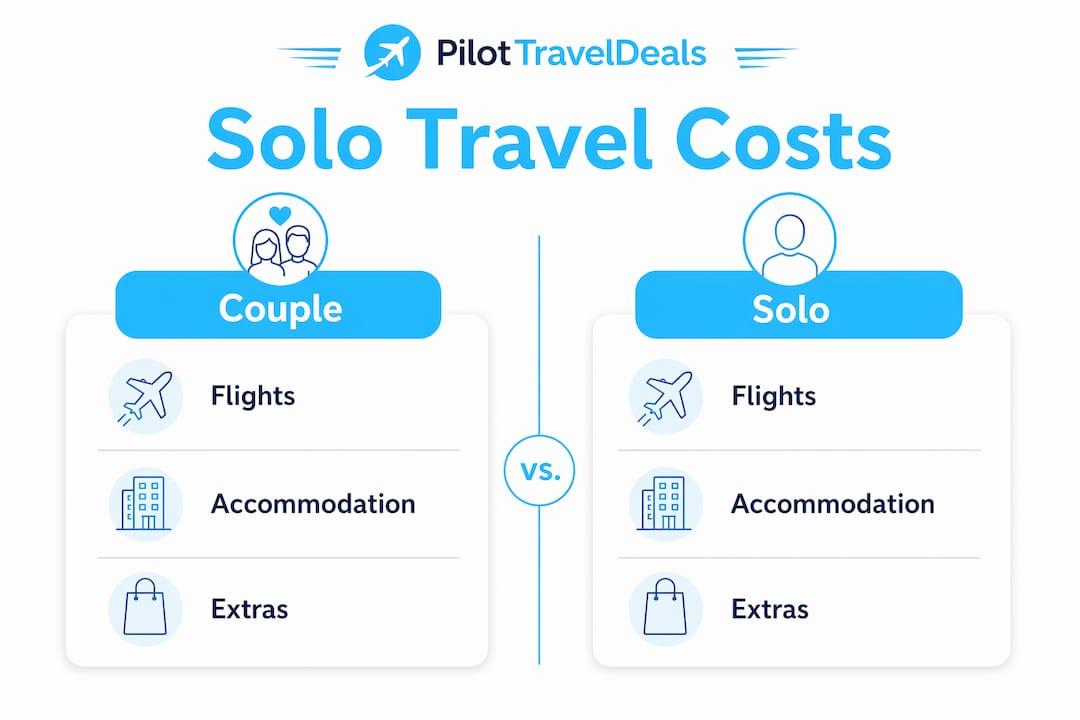
How airline revenue management creates a solo pricing gap
Airlines don’t price seats the way a store prices a shirt. Every seat on every flight sits in a fare “bucket,” and each bucket has a fixed inventory of seats available at that price. When demand rises, lower buckets sell out and only higher-priced buckets remain.

Here’s where solo travelers get caught. When two passengers search together, the algorithm looks for two adjacent seats in the same bucket. When one passenger searches, it looks for one seat — and that single seat may be the last in a cheaper bucket, or it may be priced differently because the algorithm has learned that single-seat buyers on this route are often last-minute business travelers with less price sensitivity.
The specific mechanics that produce a solo premium:
- Fare bucket depletion: Lower-priced buckets sell out faster for pairs (two seats at once), leaving single seats only in higher buckets.
- Demand segmentation: Algorithms identify solo buyers on certain routes as less price-sensitive and test higher price points.
- Ancillary bundling: Seat selection, bags, and priority boarding are priced per person, so a solo traveler absorbs 100% of those costs with no one to share them.
- Low-load route experiments: On routes with thin competition, airlines test price segmentation more aggressively.
A simple example makes the math concrete. Say a round-trip fare between two cities is listed at $280 per person when two passengers search. The same route, searched as one passenger, returns $340. That’s a $60 difference, or roughly 21% more, for the exact same seat. Over a typical trip, that adds up to a meaningful extra cost in airfare alone before you’ve touched hotels or tours.
Where else you pay more as a solo traveler
Airfare gets the headlines, but accommodation is usually where the solo cost hits hardest.

Hotels charge by the room. A double room at $160 per night costs a couple $80 each. Solo, you pay $160. Over ten nights, that’s $800 more than your paired counterpart pays per person. What makes this harder to spot: hotels rarely list a “single supplement” as a separate line item anymore. The supplement is baked into the base rate, so you’re comparing a $160 room against a theoretical $80 share without seeing the gap explicitly.
Tour operators are more explicit about it. Single supplements on group tours commonly run 20–100% above the per-person double-occupancy price, depending on the operator and destination. A tour priced at $3,200 per person based on double occupancy might carry a $600–$800 single supplement, pushing your total to $3,800–$4,000.
Cruises are among the worst offenders. Many cruise lines charge solo travelers for a cabin sized for two, sometimes at 150–200% of the per-person double rate. A handful of lines now offer dedicated solo cabins, but availability is limited and they book fast.
Private transfers and rental cars are fixed-price items. A $60 airport transfer costs $30 per person for a couple. Solo, you pay $60. Same math applies to car rentals, private guides, and chartered experiences.
Where you usually don’t pay a solo premium: per-person museum admissions, national park fees, most food and drink, and many activity-based experiences priced per head. These are the budget categories where solo travel is genuinely equal.
Practical ways to reduce or avoid the solo premium
These tactics work. Apply them in order of impact.
- Search with two passengers first, then one. On any flight search, run the same route with two passengers and note the per-person price. Then switch to one. If the price jumps, you’ve confirmed an algorithmic gap — try adjacent dates or a nearby airport.
- Use flexible-date calendars. Google Flights’ price grid and similar tools show fare variation across a full month. A Tuesday departure instead of Thursday can eliminate a solo surcharge entirely.
- Try alternate airports. On routes with multiple airport options (New York area, Chicago, Los Angeles), the pricing test may apply to one airport pair but not another.
- Build multi-city or open-jaw itineraries. Instead of a round-trip, search city A to city B, then city C back to city A. This breaks the algorithm’s pattern recognition and sometimes surfaces lower fares.
- Set fare alerts. Google Flights, Hopper, and Kayak all offer price-drop alerts. Set one for your route and let the algorithm work for you instead of against you.
- Ask hotels directly for a single-room rate. Many properties have standard rooms that are smaller and cheaper than the double listed online. Call or email and ask specifically for a single-occupancy rate — this works more often than travelers expect, especially at independent hotels.
- Look at hostels, guesthouses, and per-bed pricing. Private rooms at hostels are often 30–50% cheaper than equivalent hotel rooms, and the social environment is a bonus for solo travelers. Budget-friendly accommodation alternatives like co-living spaces and guesthouses follow the same per-bed logic.
- Share transfers through travel communities. Facebook groups, Reddit’s r/solotravel, and hostel bulletin boards regularly connect travelers heading the same direction. Splitting a $60 transfer four ways costs $15.
- Book shoulder season. Demand-based pricing means the solo premium is largest when routes are busiest. Traveling in April instead of July on the same route often closes the gap.
A few things to avoid: never book a ticket under a false name or misuse a loyalty account to simulate a second passenger. Beyond the ethical issue, airlines can cancel tickets and ban accounts for terms-of-service violations. The tactics above are all legitimate.
Pro Tip: Clear your browser cookies or use a private/incognito window before re-searching a flight. Some booking platforms adjust prices based on repeated searches. A fresh session sometimes returns a lower fare.
For a deeper look at flight search strategies that work specifically for solo flyers, Pilottraveldeals has a step-by-step guide worth bookmarking.
What solo travel actually costs: a budget framework
Solo per-person daily expenses are generally higher than a couple’s per-person costs, depending on destination and lodging choices. That gap is almost entirely driven by accommodation and fixed-cost transport. Understanding where the money goes is the first step to controlling it.
Break your budget into five buckets:
- Transportation (flights, trains, local transit, transfers)
- Accommodation (hotels, hostels, guesthouses, vacation rentals)
- Food and drink (restaurants, groceries, coffee)
- Experiences (tours, activities, admissions)
- Essentials and incidentals (SIM cards, toiletries, tips, small purchases)
The last bucket is where solo travelers consistently underestimate. Small daily purchases — a bottled water here, a taxi instead of a bus there, an unplanned snack — add $200–$400 to a two-week trip when left untracked. That’s not a rounding error; it’s a flight home.
Here’s how the math looks on a sample 7-night trip, comparing a couple’s per-person cost against a solo traveler’s:
| Budget bucket | Couple (per person) | Solo traveler | Solo premium |
|---|---|---|---|
| Flights (round-trip) | $280 | $340 | +$60 |
| Accommodation (7 nights) | $800 | $1,600 | +$800 |
| Experiences | $150 | $150 | — |
| Essentials/incidentals | $80 | $80 | — |
| Emergency buffer (10–15%) | ~$160 | $280 | +$119 |
The accommodation line does most of the damage. Experiences and food are equal. A 10–15% emergency buffer is worth building in for every solo trip — unplanned costs hit harder when there is no one to share them.
Pro Tip: Every evening, spend two minutes tallying the day’s spend against your daily budget. It takes less time than checking social media and prevents the drift that happens when you stop paying attention mid-trip.
For a full travel budgeting framework with downloadable templates, Pilottraveldeals has a dedicated guide.
Key Takeaways
Solo travelers pay more per person because most travel pricing assumes shared occupancy, and on certain U.S. routes, fare algorithms have been documented charging single passengers higher prices than pairs for identical itineraries.
| Point | Details |
|---|---|
| The solo premium is real | Airlines on some U.S. routes charge solo flyers more per person than pairs; accommodation doubles the gap. |
| Accommodation drives most of the cost | A solo traveler on a 7-night trip can pay $800 more than a couple’s per-person share just on lodging, since a $1,600 hotel bill is split between two for couples but paid in full by solo travelers. |
| Flexibility is your best counter | Searching alternate dates, airports, and passenger counts can close the airfare gap on demand-segmented routes. |
| Budget 30–60% more per day | Solo per-person daily costs typically run 30–60% higher than a couple’s; build in a 10–15% emergency buffer, as shown by recent budgeting guides. |
| Pilottraveldeals helps you search smarter | Use Pilottraveldeals to compare flight and hotel deals side by side and find lower solo rates. |
The solo premium is a trade-off, not a trap
There’s a version of this conversation that ends with “solo travel is just more expensive, full stop.” That framing is both true and useless. Yes, you lose the split-cost advantage. But you gain something that doesn’t show up in any budget spreadsheet: complete control over where the money goes.
A couple traveling together often compromises on accommodation, activities, and pace. A solo traveler can put the entire experience budget toward the one thing they actually care about — whether that’s a cooking class in Oaxaca, a better seat on a long-haul flight, or three extra nights in a city that surprised them. The premium is real, but so is the flexibility to redirect it.
The frustrating part isn’t paying more. It’s paying more without knowing why — and that’s exactly what the airline pricing system counts on. Once you understand that the gap is structural and largely algorithmic, it stops feeling personal and starts feeling like a puzzle with known solutions. Flexible dates, alternate airports, direct hotel calls, and shoulder-season timing aren’t hacks. They’re just how the system works when you know the rules.
Solo travel isn’t cheaper than traveling with a partner. But it’s not a financial penalty either. It’s differently expensive — and for the right traveler, entirely worth it.
Pilottraveldeals: built for travelers who search alone
Searching for flights and hotels as a solo traveler means you’re absorbing 100% of every fixed cost. Pilottraveldeals aggregates deals across airlines and hotel providers so you can compare options side by side — including flexible-date views that make it easier to spot when a one-day shift saves you $60 on airfare.
For accommodation, the hotel search tool filters by price and room type, which means you can quickly identify properties with true single-room pricing rather than double rooms billed at full rate. For flights, the cheap flight search guide walks you through the exact search sequence — passenger count swaps, alternate airports, flexible dates — that experienced solo travelers use to close the pricing gap. Start your next search at Pilottraveldeals.com and see what the algorithms have been hiding from you.
Useful sources
News and investigations
- Why some airlines charge solo travelers more — USA Today (2025)
Solo cost calculators and analysis
- Solo Travel Cost Calculator 2026 — NostosRoute
- Why Solo Travelers Often Pay More — Our WabiSabi Life
Budgeting guides
- Real cost of solo travel — Voyay
- Solo Travel Budget Spreadsheet Template — HerTripGuide
- Solo Travel Money Guide — Spentrip
Pilottraveldeals resources
- Solo travel money-saving tips: the ultimate guide
- How to find affordable domestic flights and save big
- Travel budgeting: smart choices for affordable trips
A note on this article: The figures and route examples cited here come from published reporting and publicly available budgeting guides. Travel pricing changes constantly — always verify current fares and hotel rates directly before booking. This article is general information, not financial or legal advice; confirm specifics with the relevant provider or a qualified travel professional for your own situation.
Recommended
- Solo travel money-saving tips: the ultimate guide – PilotTravelDeals.com
- Solo Travel Deal: Maximizing Discounts and Flexibility – PilotTravelDeals.com
- Unlocking Affordable Adventures: Tips for Cheaper Travel Without Sacrificing Fun – PilotTravelDeals.com
- Travel Budgeting – Smart Choices for Affordable Trips – PilotTravelDeals.com