
TL;DR:
- Business travel productivity generates measurable business outcomes by enhancing sales, customer retention, and decision-making. Effective planning, smooth logistics, and AI tools significantly improve travel efficiency and support organizational growth. The key to maximizing results lies in outcome-based planning, technological automation, and organizational support throughout the travel process.
Business travel productivity is defined as the measurable output a professional generates before, during, and after a work trip, converting travel time and in-person access into concrete business outcomes. The role of business travel productivity extends well beyond closing deals. Research confirms that work trips drive sales growth, customer retention, collaboration, skill development, and employee well-being. The SAP Concur Global Business Travel Survey 2026 found that 97% of CFOs view business travel as strategic to growth. That number signals a clear organizational consensus: travel is not overhead, it is investment. Executives who treat each trip as a managed project, with defined goals and measured results, consistently extract more value than those who treat travel as a logistical necessity.
How does business travel enhance productivity and what measurable outcomes result?
Business travel drives productivity through five distinct channels: new sales, customer retention, knowledge sharing, skill development, and employee well-being. Each channel produces outcomes that remote communication rarely replicates at the same depth or speed.
Face-to-face meetings accelerate decision-making. A video call can inform, but an in-person conversation builds the trust that moves a deal from negotiation to signature. Customer retention also strengthens when account managers visit clients on-site, because physical presence signals commitment in a way that email cannot. Studies on travel’s impact show productivity follows an inverted-U relationship with travel intensity. This means moderate travel frequency produces the highest gains, while excessive travel saturates returns and begins to erode performance.
Knowledge sharing is another undervalued benefit of work trips. Attending an industry conference or visiting a partner office exposes professionals to ideas and practices that never appear in internal reports. That cross-pollination often produces the most durable competitive advantages. Employee well-being also rises when travel is managed well, because a change of environment and a sense of professional purpose contribute to motivation and engagement.
- Sales growth: In-person pitches close at higher rates than remote presentations across most B2B sectors.
- Collaboration depth: Teams that meet face-to-face at least once per quarter report stronger alignment on shared goals.
- Skill development: Exposure to new markets, clients, and colleagues accelerates professional growth faster than internal training alone.
- Employee satisfaction: Well-supported travel signals organizational investment in the individual, which improves retention.
- Decision speed: Complex negotiations that stall over months in email often resolve within a single day of in-person discussion.
Pro Tip: Before booking any trip, write down three specific outcomes you expect to achieve. If you cannot name three, reconsider whether the trip is necessary.
What key challenges reduce productivity during business travel?
Travel disruptions are the single largest threat to business travel efficiency. The Blacklane report found that disruptions cause 81% of executives additional catch-up work and reduce decision-making quality in 79% of cases. Smooth travel, by contrast, boosts productivity for 93% of executives. The gap between a well-managed trip and a chaotic one is not marginal. It is the difference between arriving focused and arriving depleted.
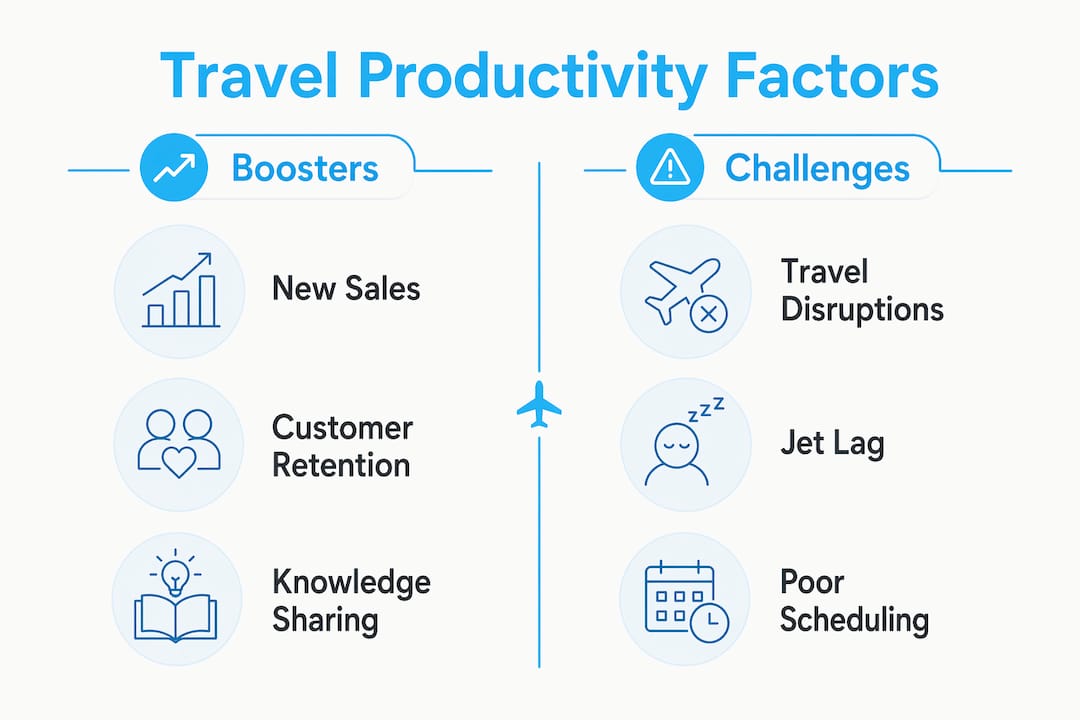
Jet lag, sensory overload in unfamiliar environments, and poor scheduling all compound the problem. A professional who lands at midnight and presents at 8 a.m. is not operating at full capacity, regardless of preparation. Poor planning also creates invisible losses. Outcome-based planning research shows that unproductive travel often manifests not during the trip itself but afterward, as work backlog and missed internal decisions accumulate while the traveler was away.
The organizational side of the problem is equally significant. GBTA’s 2026 outlook notes that travel managers are shifting from logistical execution to strategic risk and data management. When that shift is incomplete, travelers receive inadequate support and carry the cognitive burden of managing their own logistics mid-trip.
Four practical steps reduce these challenges significantly:
- Define outcomes before departure. Set specific, measurable goals for every trip. Vague objectives produce vague results.
- Build buffer time into the schedule. A 30-minute gap between landing and the first meeting is not wasted time. It is insurance against delays.
- Choose accommodations near meeting locations. Proximity cuts transit time and preserves mental energy for the actual work.
- Establish a communication protocol with your team. Agree on response windows before you leave so that urgent decisions do not pile up unanswered.
“The most productive business travelers treat logistics as a performance variable, not a background detail. Every hour saved in transit or administration is an hour available for the work that justifies the trip.”
How can technology and AI tools optimize travel planning?
Automated travel management reduces planning time by up to 90% and expense reporting by 53%, yielding a 304% ROI in the first year. One case study recorded processing time per trip dropping from 15 hours to 3.5 hours after automation was introduced. That is not a marginal efficiency gain. It is a structural shift in how much cognitive capacity a traveler retains for actual work.

AI-enabled travel tools automate bookings, detect rate drops, manage approval workflows, and generate spend reports. For small and midsize businesses, these capabilities were previously available only to large enterprises with dedicated travel departments. Machine learning now puts rate monitoring and policy compliance within reach of any organization with a travel program. Executives who use AI in travel booking report fewer last-minute surprises and more time for preparation before key meetings.
Integrated expense and booking platforms add a second layer of value. American Express research shows that integrating travel and expense systems provides real-time spend visibility, reduces manual errors, and lowers fraud risk. When managers can correlate trip costs with outcomes in a single dashboard, budget allocation becomes a data-driven decision rather than a guess.
| Technology tool | Primary productivity benefit | Key metric |
|---|---|---|
| Automated booking platforms | Reduces planning time | Up to 90% time saved |
| AI rate monitoring | Lowers trip cost | Detects drops in real time |
| Integrated expense systems | Improves ROI visibility | Reduces manual errors |
| AI approval workflows | Speeds policy compliance | Fewer delays per trip |
Pro Tip: Connect your booking platform to your expense system before your next trip. The integration eliminates duplicate data entry and gives your finance team real-time visibility without any extra work on your part.
What are best practices for maximizing productivity on work trips?
The most effective approach to business travel best practices starts with outcome definition, not itinerary building. Professionals who set clear, measurable objectives before departure consistently outperform those who plan logistics first and goals second. The trip exists to serve the outcome, not the other way around.
Scheduling decisions matter more than most executives acknowledge. Early morning departures preserve a full working day at the destination. Booking accommodations within walking distance of the primary meeting venue eliminates transit variables and reduces decision fatigue. These are not comfort preferences. They are performance choices.
Energy management is the most overlooked variable in improving travel productivity. A professional who protects sleep, limits alcohol during travel, and schedules one genuine recovery period per multi-day trip arrives at each meeting with more focus than one who treats every evening as a networking obligation.
- Set three measurable trip objectives before booking. Review them the morning of each key meeting.
- Book direct flights when the cost difference is manageable. Layovers introduce delay risk and fatigue that compound across a multi-day trip.
- Use the first hour after landing for low-stakes tasks. Respond to emails, review notes, and orient yourself before high-stakes conversations.
- Protect at least one meal per day for unscheduled thinking. Constant back-to-back meetings prevent the reflection that produces good decisions.
- Invest in relationship capital deliberately. Identify one person per trip whose relationship is worth deepening beyond the formal agenda.
The effects of travel on work are most positive when the traveler arrives with purpose and leaves with documented outcomes. Debrief within 24 hours of returning. Capture decisions made, commitments given, and follow-up actions required. That discipline converts a trip from an event into a business asset.
Key Takeaways
Business travel productivity peaks when executives combine clear outcome-based planning with technology that removes logistical friction and protects cognitive energy for high-value work.
| Point | Details |
|---|---|
| Define outcomes first | Set three measurable goals before every trip to prevent post-trip backlog and missed decisions. |
| Smooth travel drives output | Travel disruptions reduce decision quality for 79% of executives; logistics management is a performance variable. |
| Automation multiplies ROI | Automated travel management delivers a 304% first-year ROI by cutting planning time up to 90%. |
| AI tools level the field | AI rate monitoring and integrated expense platforms give midsize teams enterprise-grade travel efficiency. |
| Energy is a business asset | Protecting sleep and scheduling recovery periods produces measurably better meeting performance. |
The gap most executives miss in business travel
The conventional wisdom on business travel productivity focuses almost entirely on the trip itself. Pack efficiently, use airport lounges, answer emails on the plane. That advice is not wrong, but it addresses the wrong problem. The real productivity gap is not what happens at 35,000 feet. It is what happens in the two weeks before and after.
I have watched executives return from genuinely successful trips, deals advanced, relationships built, and then spend the next week buried in the backlog that accumulated while they were away. The trip was productive. The re-entry was not. The net result was neutral at best. Outcome-based planning solves the pre-trip side of this equation. Post-trip debriefs and pre-delegated decision authority solve the re-entry side.
The second gap is organizational. The SAP Concur survey found that employee well-being benefits from travel are significant, but perceived productivity drops due to trip complexity and lack of support are growing. Companies invest in travel budgets but underinvest in travel support infrastructure. That imbalance is fixable, and fixing it produces returns that show up in both traveler satisfaction and measurable business outcomes.
My recommendation for 2026 is to treat travel policy as a productivity policy. Every friction point in the booking, approval, or expense process is a tax on traveler performance. AI tools now exist to eliminate most of that friction. The executives and travel managers who deploy them will outperform those who do not, not because they travel more, but because they travel better.
— Asher
How Pilottraveldeals supports productive business travel
Business travel efficiency starts before you reach the airport. Pilottraveldeals helps professionals cut the time spent on logistics by aggregating hotel, flight, and connectivity options in one place, with savings of up to 80% compared to standard booking channels.
Finding a hotel near your meeting takes minutes on Pilottraveldeals, with options filtered by location and price so you can prioritize proximity over guesswork. For international trips, affordable international SIM cards keep you connected without roaming charges that inflate expense reports. Pilottraveldeals also provides cheap flight search tools that let you compare routes and departure windows to protect your schedule and your budget. Less time on logistics means more energy for the meetings that matter.
FAQ
What is business travel productivity?
Business travel productivity is the measurable output a professional generates as a direct result of a work trip, including sales closed, decisions made, and relationships advanced. It is distinct from simple travel efficiency, which measures only logistics performance.
How does business travel affect employee performance?
Smooth business travel boosts productivity for 93% of executives, while disruptions cause additional catch-up work for 81% and reduce decision quality for 79%. The quality of the travel experience directly shapes professional output.
What is the ROI of automating business travel management?
Automated travel management delivers a 304% ROI in the first year by reducing planning time up to 90% and cutting expense reporting time by 53%. Processing time per trip drops from roughly 15 hours to 3.5 hours.
How can executives measure the productivity of a business trip?
Define three specific, measurable outcomes before departure and assess each within 24 hours of returning. Outcome-focused planning prevents the hidden productivity loss that shows up as post-trip backlog and missed internal decisions.
Why do CFOs consider business travel strategic?
The SAP Concur Global Business Travel Survey 2026 found that 97% of CFOs view business travel as strategic to organizational growth, with 89% requiring travel managers to justify ROI using data and AI support. Travel is treated as a growth investment, not a cost center.
Recommended
- 7 Best Practices for Efficient Business Trip Planning – PilotTravelDeals.com
- Business travel trends to optimize efficiency and costs – PilotTravelDeals.com
- How to plan affordable business trips and maximize savings – PilotTravelDeals.com
- 7 Smart Ways to Maximize Business Travel Benefits – PilotTravelDeals.com
