
Dreaming of spacious seats and premium service but choking on business class prices? You’re not alone. Most frequent travelers want the comfort upgrade but face sticker shock at checkout. This guide delivers proven, actionable strategies to slash business class costs by 40 to 60 percent, transforming luxury travel from fantasy into affordable reality. You’ll learn the exact steps to prepare, execute, and verify cheap business class bookings that actually work.
Table of Contents
- Prerequisites: What You Need Before You Start
- Timing Your Purchase: Booking Windows To Maximize Savings
- Leveraging Airline Loyalty Programs
- Exploiting Mistake Fares And Flash Sales
- Maximizing Savings Through Flexibility
- Using Deal Aggregators And Alerts
- Common Mistakes And How To Avoid Them
- Expected Outcomes And Savings Benchmarks
- Explore PilotTravelDeals For Unbeatable Travel Savings
- Frequently Asked Questions
Key takeaways
| Point | Details |
|---|---|
| Essential setup | Join frequent flyer programs and get a travel rewards credit card before hunting deals. |
| Timing matters | Booking 3 to 6 months ahead or catching flash sales cuts costs by 20 to 35 percent. |
| Miles power savings | Redeeming airline miles for upgrades costs 20 to 50 percent less than cash tickets. |
| Technology advantage | Deal aggregators and automated alerts save 60 percent of search time while uncovering hidden offers. |
| Realistic expectations | Typical savings range from 40 to 60 percent off standard business fares with strategic planning. |
Prerequisites: what you need before you start
Before diving into deal hunting, you need the right foundation. Without these basics, you’ll miss opportunities and waste hours chasing dead ends. Think of prerequisites as your business class savings toolkit.
First, join every relevant frequent flyer program. Membership costs nothing but opens doors to upgrade offers, bonus mile promotions, and exclusive sale access. Sign up for programs covering your most traveled routes, even if you fly those airlines infrequently. Many programs credit miles from partner airlines, multiplying your earning potential.
Second, secure a premium travel rewards credit card. The best cards offer sign-up bonuses worth 50,000 to 100,000 points, enough for several upgrades. Look for cards with airline transfer partners, annual travel credits, and lounge access. The annual fee pays for itself after one or two business class bookings.
Third, invest time learning airline fare rules and upgrade policies. Each carrier has unique restrictions on upgrade eligibility, booking classes, and advance purchase requirements. Understanding these rules prevents booking economy tickets that can’t be upgraded or buying business class seats during blackout periods when better deals emerge days later.
Finally, subscribe to flight deal alert services. Free options like Google Flights alerts work well for specific routes. Premium services like Secret Flying or The Flight Deal cast wider nets, surfacing mistake fares and flash sales across hundreds of routes. Set up alerts for your target destinations and flexible date ranges.
- Frequent flyer programs unlock upgrade paths and bonus promotions
- Premium credit cards accelerate point earning and provide valuable perks
- Fare rule knowledge prevents costly booking mistakes
- Alert services automate deal discovery and save hours of manual searching
Timing your purchase: booking windows to maximize savings
When you book matters as much as how you book. Airlines use dynamic pricing algorithms that adjust fares constantly based on demand forecasts, competitor pricing, and seat availability. Your job is outsmarting these algorithms by hitting sweet spots when prices dip.
Booking 3 to 6 months ahead often secures 20 to 35 percent lower business class prices compared to last minute purchases. Airlines release inventory in waves, and early birds catch the lowest fare buckets. This window balances advance planning with avoiding the ultra-early period when airlines haven’t started discounting yet.

Flash sales represent goldmine opportunities but require vigilance. Airlines announce limited-time promotions via email and social media, typically lasting 24 to 72 hours. These sales target specific routes or travel periods, offering discounts up to 50 percent. Subscribe to airline newsletters and follow their social accounts to catch announcements immediately.
Last minute upgrades present a gambler’s choice. Airlines sometimes slash upgrade prices 24 to 72 hours before departure to fill empty business class seats. You might score 40 percent off, or you might find zero availability. This strategy works best when you’re flexible about actually getting the upgrade and can enjoy the trip either way.
Balancing these approaches depends on your travel style. Risk-averse planners should book early and celebrate guaranteed savings. Deal hunters comfortable with uncertainty can wait for flash sales or last minute opportunities, keeping backup economy tickets as insurance.
- Book 3 to 6 months out for consistent 20 to 35 percent discounts
- Monitor flash sales for limited-time 40 to 50 percent savings
- Consider last minute upgrades only with flexibility and backup plans
- Match your timing strategy to your risk tolerance and schedule constraints
Pro Tip: Set calendar reminders for 6 months, 3 months, and 6 weeks before your ideal travel dates. Check prices at each interval to identify the best booking window for your specific route.
Leveraging airline loyalty programs
Frequent flyer miles are currency for hacks to get cheaper flights, especially business class upgrades. Smart mile accumulation and redemption can cut upgrade costs dramatically while maintaining the premium experience you want.
Redeeming miles for business class upgrades costs 20 to 50 percent less than paying cash, depending on the route and airline. A transatlantic business class seat might cost $3,000 cash or 60,000 miles worth roughly $1,200 based on typical valuations. The math works even better on longer routes where cash prices soar but mile requirements stay relatively flat.
Elite status supercharges your upgrade game. Airlines prioritize elite members for complimentary and paid upgrades, often offering discounted mile rates. Achieving even basic elite status through credit card spending or mileage runs opens doors to upgrade opportunities unavailable to general members.
Earning miles extends beyond flying. Credit card sign-up bonuses provide the fastest accumulation, with premium cards offering 50,000 to 100,000 points after meeting spending thresholds. Everyday spending on dining, gas, and groceries generates ongoing miles. Airline shopping portals multiply earnings when you buy through their links, sometimes offering 5 to 10 miles per dollar on promotions.
Strategic redeeming miles for upgrades requires planning. Book economy tickets in upgrade-eligible fare classes, then request the upgrade using miles. Some airlines allow instant upgrades at booking, while others use waitlists cleared before departure. Understanding each program’s rules maximizes your success rate.
- Miles slash business class costs by 20 to 50 percent versus cash
- Elite status grants priority upgrade access and reduced mile requirements
- Credit card bonuses and everyday spending accelerate mile earning
- Strategic redemption combines fare class knowledge with upgrade timing
“Airline miles represent the most accessible path to affordable business class for frequent travelers. The key is treating mile accumulation as a deliberate strategy, not a passive benefit.”
Exploiting mistake fares and flash sales
Mistake fares are pricing errors that slip through airline systems, offering jaw-dropping discounts of 70 to 80 percent off normal business class fares. These golden tickets require quick action and careful verification, but the savings justify the effort.
Mistake fares happen when airlines or booking engines miscalculate currency conversions, apply wrong fare rules, or suffer technical glitches. A $5,000 business class ticket might appear for $500. These errors get corrected within hours, sometimes minutes. Your window to book is tiny.
Monitor social media channels like Twitter, where deal communities share mistake fares instantly. Follow accounts like Secret Flying, The Flight Deal, and airline-specific deal hunters. Specialized forums like FlyerTalk have dedicated mistake fare threads with real-time discussions and verification.
Before clicking purchase on a suspected mistake fare:
- Verify the deal appears on multiple booking platforms
- Check airline’s official website to confirm the price
- Read cancellation policies carefully in case the airline voids the ticket
- Use a credit card offering purchase protection
- Screenshot everything including confirmation numbers and fare details
- Book immediately if verification checks out
Understanding risks protects you from disappointment. Airlines can cancel mistake fare bookings, though many honor them to avoid bad publicity. Using credit cards with strong dispute resolution gives you leverage if issues arise. Never book non-refundable hotels or activities until your ticket is confirmed and past the likely cancellation window of 24 to 72 hours.
Flash sales differ from mistake fares by being intentional promotions. Airlines announce these sales to fill seats during slow periods or compete with rivals. Sign up for airline email lists and enable app notifications to catch announcements immediately.
- Mistake fares offer 70 to 80 percent discounts but vanish within hours
- Twitter and deal forums provide fastest alerts for time-sensitive opportunities
- Verify deals across platforms before booking to avoid scams
- Credit card protection and screenshots document purchases if disputes arise
- Flash sales are legitimate promotions requiring fast action on announced routes
Pro Tip: Create a spreadsheet with your dream destinations and target business class prices. When mistake fares or flash sales appear, you can instantly decide if the deal meets your threshold without analysis paralysis costing you the opportunity.
Maximizing savings through flexibility
Flexibility is your secret weapon for smart ways to find cheap tickets. Being rigid about dates, airports, and routes guarantees you’ll pay premium prices. Opening your options unlocks hidden deals and savings up to 40 percent.
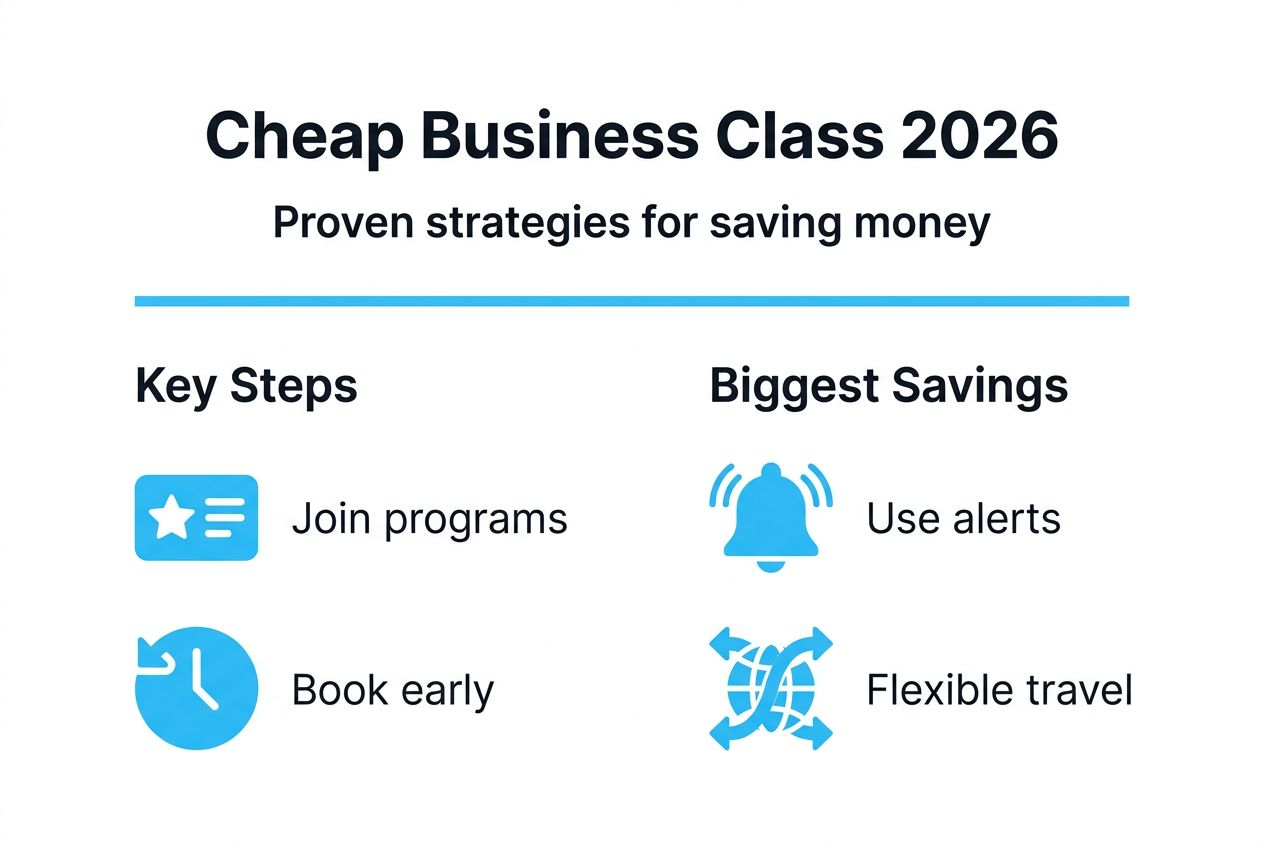
Travel dates make huge differences. Mid-week flights on Tuesday, Wednesday, and Thursday cost significantly less than weekend departures. Business travelers drive weekend demand, pushing prices up. Leisure travelers willing to depart Wednesday and return Tuesday save 25 to 40 percent on identical routes.
Alternate airports multiply your deal opportunities. Major cities often have multiple airports within reasonable distances. Flying into Oakland instead of San Francisco, or Burbank instead of LAX, can save hundreds while adding minimal ground transportation time. Check all nearby airports when searching.
Multi-city and open-jaw itineraries sometimes cost less than round trips. Instead of New York to London and back, price New York to London, then Paris to New York. You might save 20 percent while visiting an extra city. This works because airlines price segments independently, and competitive routes get deeper discounts.
Here’s how flexibility impacts real prices:
| Route | Weekend Round Trip | Mid-Week Round Trip | Savings | Alternate Airport Option | Additional Savings |
|---|---|---|---|---|---|
| New York to London | $3,200 | $2,400 | $800 (25%) | Newark to Gatwick | $300 (9%) |
| Los Angeles to Tokyo | $4,500 | $3,200 | $1,300 (29%) | Burbank to Narita | $450 (10%) |
| Chicago to Paris | $3,800 | $2,800 | $1,000 (26%) | Milwaukee to Orly | $400 (11%) |
- Mid-week travel saves 25 to 40 percent compared to weekend flights
- Alternate airports add 10 to 15 percent extra savings on top of date flexibility
- Open-jaw routing creates opportunities for lower combined segment pricing
- Maximum flexibility stacks multiple strategies for compound savings
Using deal aggregators and alerts
Manual searching across airline websites wastes hours and misses deals. Deal aggregators and automated alerts let technology work for you, finding cheap business class tickets while you focus on other priorities.
Aggregators save up to 60 percent of search time by querying hundreds of airlines and booking sites simultaneously. Google Flights, Kayak, and Skyscanner dominate the space, each with unique strengths. Google Flights excels at flexible date searches and price tracking. Kayak offers powerful filters for specific aircraft types and amenities. Skyscanner searches smaller international carriers others miss.
Setting up travel deal alerts automates the hunting process. Configure alerts for your target routes, preferred travel dates, and maximum acceptable prices. You’ll receive emails or app notifications when deals matching your criteria appear. This passive approach catches opportunities without daily manual checking.
Cross-checking deals protects against scams and ensures legitimacy. When an aggregator surfaces an amazing price, verify it on the airline’s official website before booking. Third-party booking sites sometimes display outdated prices or add hidden fees at checkout. The 30 seconds spent verifying saves headaches later.
Optimizing your alert strategy requires some experimentation:
- Set price alerts 10 to 15 percent below current fares to catch real deals, not minor fluctuations
- Enable notifications for flexible date ranges, not just specific days
- Subscribe to multiple aggregators since each finds unique deals
- Review and adjust alert thresholds monthly based on seasonal pricing patterns
Top aggregator tools include Google Flights for comprehensive coverage, Hopper for price prediction algorithms, and Scott’s Cheap Flights (now Going) for curated mistake fares and deals. Combining free Google Flights alerts with a premium service like Going covers both automated and human-curated opportunities.
The cheap airfare tips you implement through aggregators compound over time. Each booking teaches you patterns for your preferred routes, helping you recognize genuinely exceptional deals versus normal fluctuations.
- Aggregators query hundreds of sources simultaneously, saving 60 percent of manual search time
- Automated alerts catch deals 24/7 without constant monitoring
- Cross-checking on airline websites prevents scam bookings and hidden fees
- Combining multiple aggregator tools maximizes deal coverage and variety
Common mistakes and how to avoid them
Even experienced travelers make errors that cost hundreds or thousands in lost savings. Learning these pitfalls helps you sidestep expensive mistakes and maximize your business class deal hunting success.
Ignoring deal alerts causes missing 30 to 40 percent of potential savings opportunities. Travelers set up alerts, then disable notifications or let emails pile up unread. Deals vanish within hours. Solution: Create a dedicated email folder for deal alerts, check it daily, and enable high-priority notifications for your most wanted routes.
Misunderstanding fare rules leads to booking tickets that can’t be upgraded or changed without massive fees. Not all economy tickets qualify for mileage upgrades. Some cheap business class fares prohibit changes entirely. Solution: Read the complete fare rules before purchasing, not after. Look for upgrade eligibility, change fees, and cancellation policies.
Delaying action on mistake fares results in lost opportunities. Travelers see an incredible deal, spend an hour researching the destination, and return to find the price corrected. Mistake fares require immediate booking, research later. Solution: Maintain a wish list of destinations where you’d jump on deals instantly. When mistake fares appear for those places, book first and finalize plans after.
Booking too early sometimes costs more than waiting. Airlines occasionally release inventory 11 to 12 months out at high prices, then discount closer to departure. Booking immediately locks you into inflated rates. Solution: Track historical pricing for your routes to identify optimal booking windows, typically 3 to 6 months before travel.
Forgetting to clear cookies and browser cache can show inflated prices. Some booking sites track your searches and raise prices on repeat visits, creating false urgency. Solution: Search in private/incognito mode or clear your browsing data between sessions.
- Check deal alerts daily to avoid missing time-sensitive opportunities
- Read complete fare rules before purchasing to prevent upgrade eligibility surprises
- Book mistake fares immediately, research destinations after
- Track historical pricing to identify optimal booking windows
- Search in incognito mode to prevent cookie-based price inflation
Pro Tip: Set up a simple tracking spreadsheet with columns for route, date searched, price, and fare class. Review it weekly to spot pricing patterns and optimal booking windows for your most traveled routes.
Expected outcomes and savings benchmarks
Understanding realistic expectations prevents disappointment and helps you evaluate whether strategies are working. Business class deals deliver substantial savings, but the exact amounts vary based on routes, timing, and effort invested.
Typical savings range from 40 to 60 percent off normal business class fares when you consistently apply these strategies. A $4,000 transatlantic ticket might cost $2,000 to $2,400 using miles, flash sales, or optimal booking timing. Mistake fares occasionally push savings to 70 or 80 percent, but these remain rare exceptions, not everyday occurrences.
Time investment varies dramatically by approach. Using aggregators with automated alerts requires just 1 to 2 hours of initial setup, then 15 to 30 minutes weekly reviewing deals. Manual searching across airline sites demands several hours per booking. The choice depends on whether you value time savings or enjoy the hunt.
Advance booking offers certainty at the cost of maximum savings. Booking 3 to 6 months ahead guarantees 20 to 35 percent discounts but means missing potentially better deals closer to departure. Last minute approaches risk availability issues but occasionally yield 50 percent savings. Most travelers find a hybrid approach optimal, booking refundable tickets early, then watching for better deals.
Here’s how different strategies compare:
| Strategy | Average Savings | Time Investment | Certainty Level | Best For |
|---|---|---|---|---|
| Advance Booking | 20 to 35% | 2 to 3 hours | High | Planners needing guaranteed travel |
| Miles Upgrades | 30 to 50% | 3 to 5 hours | Medium | Frequent flyers with point balances |
| Flash Sales | 40 to 55% | 1 hour + monitoring | Medium | Flexible travelers on popular routes |
| Mistake Fares | 70 to 80% | Continuous monitoring | Low | Deal hunters with total flexibility |
| Aggregator Alerts | 35 to 50% | 30 min weekly | Medium | Busy professionals wanting automation |
Realistic expectations include acknowledging trade-offs. Cheaper business class often means less convenient flight times, longer connections, or restrictive change policies. Decide which compromises you’ll accept before hunting deals.
Success builds over time. Your first business class deal might take weeks to find and save 30 percent. After six months of practicing these strategies, you’ll spot deals instantly and regularly achieve 50 percent savings. The learning curve pays dividends across future bookings.
Explore PilotTravelDeals for unbeatable travel savings
Ready to put these strategies into action? PilotTravelDeals simplifies finding cheap business class tickets and maximizing your travel budget across all trip components. Our platform aggregates deals from hundreds of airlines and booking sites, delivering the opportunities you need without hours of manual searching.
Explore our comprehensive cheap airfare tips guides for deeper insights into booking strategies that work. Combine your business class savings with discounted accommodations through our hotel deals section, stretching your travel budget even further. Visit PilotTravelDeals today to discover your next affordable luxury travel experience. Every dollar saved on flights means more resources for unforgettable experiences at your destination.
Frequently asked questions
How can I find last-minute business class upgrades cheaply?
Check airline mobile apps 24 to 72 hours before departure when carriers often slash upgrade prices to fill empty seats. Monitor upgrade availability daily as departure approaches. Set alerts for your confirmation number to receive instant notifications when upgrade offers appear. Flexibility about actually getting upgraded is essential since availability remains unpredictable.
Are airline miles always the best way to get business class tickets cheap?
Miles provide excellent value on long-haul international routes where cash prices exceed $3,000 but remain just one tool among many. Flash sales and mistake fares sometimes beat mile redemptions, especially on competitive routes during promotional periods. Compare cash prices, mile requirements, and current deals before deciding. The best approach combines miles with sale monitoring for maximum flexibility.
What are mistake fares and how risky are they to book?
Mistake fares are unintentional pricing errors offering 70 to 80 percent discounts, typically corrected within hours of discovery. Airlines can legally cancel these bookings, though many honor them to avoid negative publicity. Book using credit cards with strong dispute resolution and screenshot all confirmation details. Verify deals through multiple sources before purchasing to avoid scams masquerading as mistakes.
How much time should I expect to invest searching for cheap business class tickets?
With aggregators and automated alerts, initial setup takes 1 to 2 hours, then 15 to 30 minutes weekly reviewing deals. Manual searching requires several hours per booking to compare airlines and dates. Your time investment decreases as you learn pricing patterns for preferred routes. Most travelers find the hybrid approach of alerts plus occasional manual checking optimal for balancing time and savings.
