
TL;DR:
- Solo travel expenses quickly add up without strategic planning, especially with single-supplement surcharges and transport costs. Building a realistic budget, booking flights flexibly, and choosing neighborhoods away from tourist hotspots can significantly reduce costs. Using tools like real-time trackers and planning for emergencies ensure a safer, more affordable adventure.
Solo travel is one of the most rewarding ways to see the world, but without a partner to split the hotel bill or cab fare, your travel expenses for solo travelers add up fast. A single-occupancy surcharge here, a solo taxi there, and suddenly you’re burning through cash you never planned to spend. These solo travel money-saving tips are built specifically for budget-conscious travelers who want to go further without going broke. From building a realistic budget to booking flights strategically and avoiding the daily traps that quietly drain your wallet, this guide covers every stage of your trip.
Table of Contents
- Understanding solo travel costs and budgeting essentials
- How to save big on flights: booking smart for solo travelers
- Finding affordable accommodation and cutting hidden daily costs
- Managing money while traveling: safety and budget tracking tips
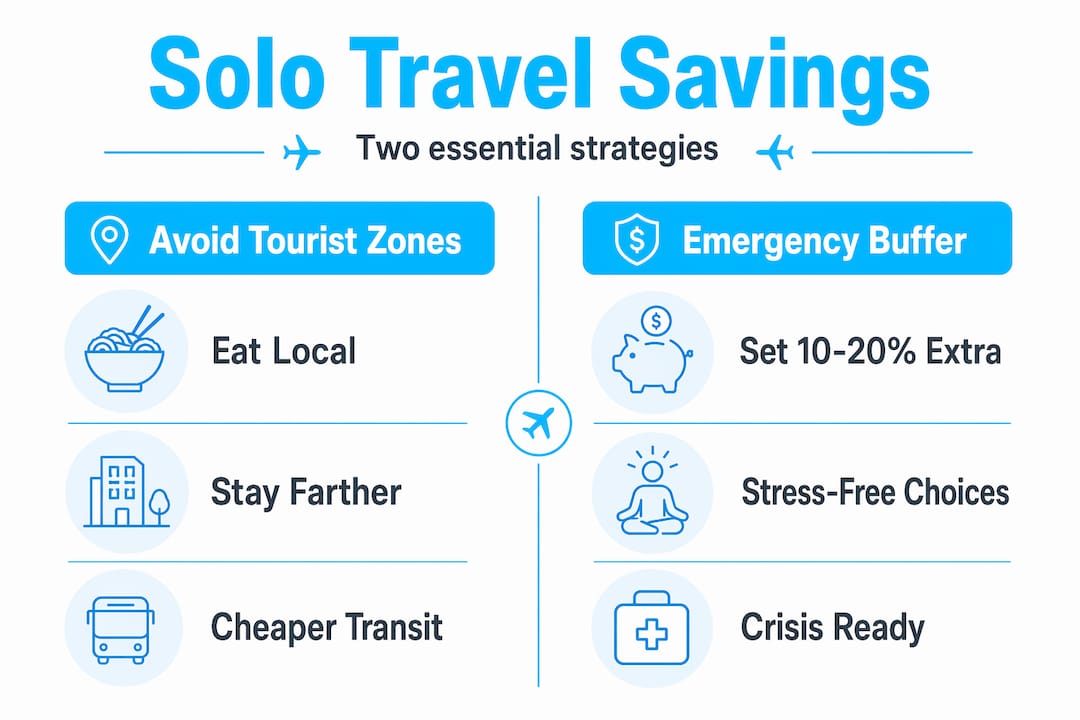
- Why avoiding tourist zones and preparing an emergency buffer are your secret weapons
- Unlock exclusive solo travel deals with PilotTravelDeals.com
- Frequently asked questions
Key Takeaways
| Point | Details |
|---|---|
| Plan your budget carefully | Separate your fixed and variable costs and add a 10–20% emergency buffer to cover unexpected expenses. |
| Book flights strategically | Use midweek booking windows, set fare alerts, and shift departure dates to save hundreds on airfare. |
| Avoid tourist zone markups | Stay and eat at least 10 minutes away from tourist landmarks to cut food and transport costs by up to 60%. |
| Manage money securely | Use multiple payment methods, minimize foreign transaction fees, and track spending daily with apps. |
| Operationalize your emergency fund | Treat your financial buffer as a real safety net, helping you avoid costly last-minute changes and stress. |
Understanding solo travel costs and budgeting essentials
Good solo travel budgeting tips start before you book anything. The first step is separating your fixed costs from your variable costs. Fixed costs are everything you pay once: flights, travel insurance, visas, and airport transfers. Variable costs are what you spend every day on food, local transport, entry fees, and activities. Most travelers blur these two categories together and end up confused about why their budget collapsed mid-trip.
Start by adding up all your fixed costs. Then subtract that total from your overall travel budget. What remains is your daily spending allowance. Divide it by the number of days you’ll be traveling, and you have a clear daily limit to work with.
A critical solo travel budgeting step that most guides skip: building an emergency buffer. An emergency buffer of 10 to 20% of your total projected budget covers the unexpected moments that every solo trip produces. A canceled flight, a stolen wallet, a sudden illness, these events don’t care about your spreadsheet. The good news is that a 10 to 20% financial cushion keeps you from raiding your essential travel funds when something goes wrong.
To put this into practice, use a budgeting app like Trail Wallet or TravelSpend to track spending in real time. Knowing you’ve hit 80% of your daily limit by 3 PM changes your behavior in ways that simply “trying to be careful” never does.
Here’s a quick reference for what typical daily budgets look like in popular solo travel regions:
| Region | Budget daily cost (USD) | Includes |
|---|---|---|
| Southeast Asia | $25 to $40 | Hostel/guesthouse, meals, local transport |
| Eastern Europe | $40 to $65 | Budget hotel/hostel, meals, transport |
| Western Europe | $80 to $130 | Budget hotel, meals, public transit |
| Central America | $30 to $55 | Guesthouse, street food, local buses |
| South America | $35 to $60 | Hostel, meals, local transport |
These numbers assume you’ve already made smart travel budgeting choices on flights and accommodations before you arrive.
Key steps to build your solo travel budget:
- List all fixed costs (flights, insurance, visas, vaccinations)
- Subtract fixed costs from your total available budget
- Divide the remainder by trip days to get your daily limit
- Add 10 to 20% emergency buffer on top of your total
- Pick a real-time tracking app before you leave home
Pro Tip: Before departure, research the typical cost of a local SIM card and a 7-day transit pass in your destination. Adding these to your fixed cost list avoids surprises that eat into your first few days.
How to save big on flights: booking smart for solo travelers
Flights are usually the largest single line item in any budget solo travel plan. Getting this right can fund several extra days of travel. These money-saving travel hacks for flights work best when you combine timing, tools, and a little flexibility.
Shifting a long-haul departure by just two days and using Google Flights’ price calendar can save $150 to $300 on certain routes. Over a year of solo travel, that kind of flexibility adds up to a free trip.
Here’s how to approach flight booking as a solo traveler:
- Use Google Flights’ price calendar. Switch to the calendar view and scan a 30-day window. The cheapest dates often aren’t what you assumed.
- Search on Tuesdays or Wednesdays. Booking midweek consistently delivers better prices. Avoid searching on Fridays or Sundays when leisure demand peaks.
- Set fare alerts. Tools like Hopper or Skyscanner will notify you when a price on your route drops. Set the alert, then wait. Patience is free.
- Shift your dates by 2 days. If flying out on a Friday costs $480, try Wednesday. The route is identical. The price often isn’t.
- Consider open-jaw routing. Flying into one city and out of another eliminates the cost and time of backtracking. For a Europe trip, fly into Lisbon and out of Prague instead of paying for a return to Lisbon.
- Book 1 to 6 months out. That window gives you the best range of prices without the premium of last-minute panic buying.
Pro Tip: When a third-party site shows only $10 to $15 savings over the airline’s own site, book direct. You’ll have far better options if your flight gets delayed or canceled, and you won’t deal with a middleman when something goes wrong.
For a deeper look at applying these solo travel deal strategies to your specific routes, or to search cheap flights across multiple carriers at once, the right comparison tools make a real difference.
Finding affordable accommodation and cutting hidden daily costs
Budget solo travel advice rarely goes deep enough on this: your accommodation address matters as much as its price. Staying within walking distance of a major tourist landmark almost always costs more, and not just in room rates.
Staying and eating just 10 minutes away from major tourist landmarks can reduce prices by 40 to 60%. That applies to your accommodation, your meals, your coffee, and even the convenience stores nearby. The savings are structural, not a one-time deal.
Here’s how the price difference looks in practice:
| City | Meal near landmark | Meal 10 min away | Savings |
|---|---|---|---|
| Bangkok | $8 to $12 | $2 to $4 | Up to 70% |
| Rome | $18 to $30 | $8 to $14 | Up to 55% |
| Barcelona | $15 to $25 | $7 to $12 | Up to 50% |
| Bali | $6 to $10 | $2 to $4 | Up to 60% |
The biggest hidden budget drain for most solo travelers isn’t accommodation; it’s daily transport and eating near tourist zones. Most people optimize their hotel and then hemorrhage money three times a day at restaurants next to the Colosseum.
Practical moves for cutting daily costs on the road:
- Book hostels with private pods for security and quiet without the full hotel price
- Use Airbnb weekly rates on stays of 7 or more nights, the per-night cost often drops 20 to 30%
- Never book tours or dining through your hotel concierge. The markup for that convenience is real and unnecessary
- Walk between neighborhoods instead of taking taxis for short trips
- Buy a weekly or multi-day public transit pass on your first day. It pays for itself faster than you’d expect
Pro Tip: Download an offline map (Google Maps works offline if you save the area in advance) before heading out. It lets you navigate to local restaurants and markets safely, without burning mobile data or depending on Wi-Fi.
To identify affordable solo travel destinations where your daily budget stretches furthest, or to compare hotel booking options across price points and locations, doing your research before you land pays off immediately.
Managing money while traveling: safety and budget tracking tips
How you handle money on the road is one of the most practical solo travel money-saving tips there is. Bad habits here add a quiet tax to every transaction.
Foreign ATM and transaction fees can add 3 to 5% to your overall trip budget. On a $3,000 trip, that’s up to $150 gone in fees alone. The fix is simple: use a travel credit card that waives foreign transaction fees, and plan larger ATM withdrawals less frequently rather than small withdrawals daily.
Layered risk management with duplicate documents and multiple payment methods prevents a single bad event from becoming a financial emergency. A pickpocket taking one wallet shouldn’t be able to strand you.
Here’s a checklist of smart money habits for solo travelers:
- Use a credit card that waives foreign transaction fees (Charles Schwab’s debit card and Wise are popular choices)
- Withdraw larger amounts less often to minimize per-transaction ATM fees
- Keep a copy of your passport, insurance card, and emergency contacts in a separate bag from the originals
- Store cash and cards in at least two physically separate locations on your body or in your bag
- Always pay in local currency when given the choice between local and your home currency at the register (the “dynamic currency conversion” option almost always uses a terrible exchange rate)
- Skip airport currency exchange desks entirely. The rates are designed for people in a hurry
Pro Tip: Use an eSIM or local SIM card instead of activating international roaming through your home carrier. Roaming plans from major carriers often cost $10 or more per day. A local SIM frequently costs that much for an entire week. You can compare SIM card options for your destination before you depart.
Track your spending every evening. It takes five minutes and completely changes how you make decisions the next day. A spreadsheet works fine. So does a dedicated app. What doesn’t work is trying to remember everything at the end of the trip.
For additional travel safety tips that protect both your security and your budget, preparation done before departure costs nothing.
Why avoiding tourist zones and preparing an emergency buffer are your secret weapons
Here’s a view you won’t find in most how to save money while traveling alone articles: the two biggest levers in solo travel budgeting aren’t clever flight hacks or loyalty points. They’re geographic discipline and a financial buffer you never plan to touch.
Most travelers spend enormous energy finding a cheap hotel, then walk five minutes to the nearest café next to the main square and pay three times the local price for breakfast every morning for two weeks. The math on that is brutal. If a tourist-zone breakfast costs $12 instead of $4, that’s $112 extra over 14 days from one meal. Add lunch, coffee, and dinner, and you’ve spent $300 to $400 more than necessary, simply because of where you sat down.
The 10-minute walk rule is simple but powerful. After applying it consistently across three trips, I tracked roughly $1,200 in savings over the course of a year, just from eating and drinking outside tourist corridors. That’s a flight.
As the biggest hidden budget drain comes from daily transport and eating near tourist zones, not accommodation, the fix isn’t to find a cheaper hotel. It’s to walk away from the crowd before you open your wallet.
The emergency buffer deserves equal respect. Most travelers see it as a theoretical safety net, something nice to have but rarely structured. In practice, building that emergency buffer into your budget from the start converts a financial shock into a minor inconvenience. A flight rebooked at the last minute, an urgent doctor’s visit, a bag replacement after theft: these events happen. The traveler who has budgeted for them calmly books a new flight. The traveler who hasn’t goes into debt or cuts the trip short.
Reframe both of these as structural decisions, not willpower decisions. Choose your accommodation first based on neighborhood, not proximity to the main attraction. Build the buffer into your budget before you calculate how much you have to spend daily, not after. These two smart travel budgeting moves shift you from reactive to proactive, and that shift is worth more than any coupon code.
Pro Tip: When researching accommodation, open a map and look for where local people eat, not just where the reviews cluster. Pick a hotel or hostel near that local area first. Then plan your sightseeing outward from there, not the other way around.
Unlock exclusive solo travel deals with PilotTravelDeals.com
Applying these tips starts with having the right tools and resources in your corner. At PilotTravelDeals.com, we’ve built a set of guides and comparison tools specifically designed to help solo travelers book smarter and spend less at every stage of the trip.
Whether you’re mapping out your affordable domestic flights guide, working through a solo traveler booking guide for accommodations and transport, or looking for travel SIM cards to stay connected without roaming fees, we’ve got the comparison tools to find the best price fast.
Here’s what you can access right now:
- Flight deal comparisons across multiple carriers to find your cheapest window
- Hotel and hostel booking tools with filters for budget, neighborhood, and amenities
- SIM card deals for popular destinations so you arrive connected without the shock of a roaming bill
- Destination guides written specifically for budget-conscious solo travelers
- Expert articles covering everything from visa costs to daily budget benchmarks by region
By applying the proven strategies in this guide and using these resources as your planning toolkit, you have everything you need to travel solo, affordably, and on your terms.
Frequently asked questions
How much should I budget daily for a solo trip to Southeast Asia?
Daily budgets in Southeast Asia typically range from $25 to $40 for budget travelers, covering a guesthouse or hostel bed, local meals, and basic transport. Staying outside tourist zones and using local transit keeps you comfortably within that range.
When is the best time to book flights to get the lowest prices?
Booking 1 to 6 months in advance and flying midweek, particularly on Tuesdays or Wednesdays, consistently produces the lowest prices for solo travelers. Searching on those same days also tends to surface better fares than weekend browsing.
Why is it important to keep an emergency budget buffer while traveling solo?
An emergency buffer of 10 to 20% absorbs real-world shocks like canceled flights, medical visits, or stolen items without forcing panic spending or cutting your trip short. It’s the single most underused tool in solo travel budgeting.
How can I avoid spending too much on food near tourist attractions?
Eating near tourist zones can double or triple the price of a meal compared to spots just 10 minutes away on foot. Make it a rule to walk away from the main square before sitting down, and your food budget will reflect the difference within a day or two.
Recommended
- Budget travel guide: Proven strategies to save on every trip – PilotTravelDeals.com
- Smart Overseas Flight Tips: Save More and Travel Better – PilotTravelDeals.com
- 10 Essential Budget Travel Tips for Smart Travelers – PilotTravelDeals.com
- 8 Smart Ways to Travel for Cheap and Save Big Money – PilotTravelDeals.com

