
TL;DR:
- Booking directly with an airline is often not the lowest fare due to complex pricing and restrictions. Flight agents, whether human or online, access exclusive fares, consolidator contracts, and manage complex itineraries to save travelers money. Using a combination of research and expert assistance maximizes savings, especially for multi-leg, group, or flexible travel plans.
Most travelers assume that booking directly with an airline automatically gets them the lowest fare. It’s a logical assumption, but it’s wrong more often than you’d think. Modern airfare pricing is a moving puzzle of fare classes, blackout dates, consolidator rates, and multi-airline routing rules that even experienced travelers rarely navigate well. Flight agents, both human specialists and specialized online booking services, sit in the middle of that complexity and know how to work it to your advantage. This article breaks down exactly when and how to use them to keep more money in your wallet.
Table of Contents
- What are flight agents and how do they work?
- When to use a flight agent versus booking direct
- How flight agents can maximize budget traveler savings
- Tips for budget travelers: getting the most from flight agents
- Why the best airfare deals require both DIY and expert help
- Find and compare the best flight and travel deals with PilotTravelDeals
- Frequently asked questions
Key Takeaways
| Point | Details |
|---|---|
| Flight agents excel on complex trips | They are most helpful for multi-leg, group, or international travel rather than simple point-to-point routes. |
| Direct booking can be cheapest and simplest | Booking directly with airlines works well for straightforward itineraries and provides more control. |
| Mix and match for bigger savings | Using both flight agents and your own research tools is the best way to find the lowest fares. |
| Understand agent fees and terms | Always check for extra charges, cancellation policies, and service agreements before buying. |
| Use comparison sites to your advantage | Flight aggregators help you spot more deals and choose the best booking method for your needs. |
What are flight agents and how do they work?
A flight agent is any person or service that books airline tickets on your behalf, using access and expertise that goes beyond what a regular traveler can get on their own. That covers two main types: traditional agents (human travel advisors who specialize in airfare) and online travel agencies, commonly called OTAs, which let you self-service your booking through a digital platform.
What separates a real flight agent from a basic search engine is their toolkit. Skilled agents work with:
- Global Distribution Systems (GDS): Airline inventory systems like Sabre, Amadeus, or Travelport that show unpublished fares and seat availability invisible to the public.
- Consolidator contracts: Private agreements with airlines that give agents access to fares below standard retail prices.
- Fare construction rules: The ability to build multi-stop or open-jaw itineraries (flights where you arrive in one city and depart from another) in ways that can dramatically reduce the total ticket cost.
- Group booking systems: Access to block-seat contracts for parties of 10 or more.
- Itinerary management: Proactive monitoring and re-ticketing when fares drop or schedules change.
OTAs, aggregators, and direct airline booking all serve different purposes. OTAs like Expedia or Kayak are essentially self-service storefronts. Aggregators like Google Flights pull prices from multiple sources but don’t actually sell tickets. Direct airline booking gives you the cleanest relationship with the carrier. The advantages of booking sites for budget travelers are real, but they work best when the trip is simple.
When an itinerary gets complex, that’s where a human agent outperforms every automated tool. Third-party platforms can help travelers compare multiple airline options and manage entire trips in one place, which matters enormously for multi-leg international trips.
Pro Tip: To verify an agent’s credentials, look for membership in IATA (International Air Transport Association), ASTA (American Society of Travel Advisors), or CLIA. These organizations require ethical standards and professional training. A quick Google search of the agent’s name plus their agency and “IATA accredited” takes less than two minutes and can save you from serious problems.
When to use a flight agent versus booking direct
Knowing the tools exist is only half the battle. The real skill is knowing when each one gives you the best result.
Here’s a quick decision framework to guide your choice:
- Trip type: Is your trip a simple round trip on one airline? Book direct. Are you crossing multiple countries, using different carriers, or mixing premium and economy cabins? Call an agent.
- Group size: Traveling with 8 or more people? An agent’s group contracts will almost always beat any published fare.
- Flexibility needs: If you might need to change dates, an agent can sometimes lock in flexible ticketing rules that aren’t available in standard retail booking.
- Service complexity: Adding premium upgrades, special meals, extra baggage allowances, or assistance for travelers with disabilities is far easier through an agent who handles these details daily.
- Time value: If researching fares, building itineraries, and monitoring price changes would cost you 5 to 10 hours of your time, an agent’s service fee often pays for itself.
“If your trip is simple and you can book direct with the airline, direct often wins on control and clarity. If your itinerary is complex, you may get convenience and value from OTAs or from an air-specialist agent, provided you understand their fee, cancellation, and change mechanics.” — Travel + Leisure
Here’s a side-by-side breakdown to help you decide:
| Factor | Direct booking | Flight agent | OTA or aggregator |
|---|---|---|---|
| Best for | Simple routes | Complex or group trips | Price comparison |
| Fare access | Published only | Consolidator and private | Published and some exclusive |
| Customer service | Airline directly | Agent handles issues | Varies by platform |
| Change and cancellation | Airline policies | Agent may negotiate | OTA policies apply |
| Typical cost | Base fare | Fee plus possible savings | Base fare plus markup |
| Itinerary flexibility | Low | High | Medium |
Understanding direct flights and their advantages helps you recognize exactly when it makes sense to skip the middleman. But for mixed-airline itineraries or group travel, choosing the best travel deals usually requires a deeper comparison approach than direct booking offers.
One caution: always ask an agent upfront about their fee structure, their cancellation terms, and who handles your ticket if the airline makes a schedule change. These mechanics matter more than people realize until something goes wrong.
How flight agents can maximize budget traveler savings
Here’s where things get genuinely interesting for anyone traveling on a tight budget. Flight agents don’t just add convenience. In the right circumstances, they can put real money back in your pocket.
Consider a practical example. A family of 12 traveling from Chicago to Cancun for a reunion tries to book independently online. The best published fare they find is $340 per person round trip, totaling $4,080. They contact an agent who works with group airfare contracts and secures a blocked group rate of $265 per person, dropping the total to $3,180. That’s $900 in savings before the agent even negotiates baggage fees or seat assignments. This type of outcome is common, not exceptional.

Here’s a look at where agents can realistically create savings compared to standard direct booking:
| Scenario | Direct booking cost | Agent booking cost | Estimated saving |
|---|---|---|---|
| Group of 12, international | $4,080 total | $3,180 total | $900 |
| Multi-stop with 3 airlines | $1,200 per person | $890 per person | $310 |
| Last-minute business class | $4,500 per person | $3,100 per person | $1,400 |
| Flexible fare with changes | $800 plus $200 fee | $880 all-in | $120 saved in risk |
Agents who work with airlines offering group discounts often have direct contacts at airline group desks, letting them negotiate extras like free name changes, complimentary upgrades for trip organizers, or reduced deposits.
Budget travelers often focus only on the ticket price and miss the hidden fees that quietly inflate total costs. Agents can help you navigate:
- Seat selection fees that airlines charge separately from the fare
- Checked baggage pricing that varies wildly across carriers on the same route
- Credit card surcharges that some OTAs apply at checkout
- Fare class restrictions that make a “cheap” ticket unusable for changes
- Fuel surcharges embedded in business-class awards that most travelers don’t spot
Third-party platforms can help compare multiple airline options for complex itineraries, and a sharp agent uses those same resources plus their private contracts to build the lowest total cost picture.
Pro Tip: Ask your agent specifically about “consolidator fares” or “net fares.” These are wholesale tickets airlines sell to agents at discounted prices not available to the public. Agents are not always required to volunteer this information, but if you ask directly, a trustworthy agent will be transparent. A consolidator fare on a long-haul international flight can be 20 to 40 percent below the published price.
Watch out for common traps: agents who guarantee the lowest price without conditions, push unnecessary travel insurance policies with high commissions, or refuse to give you the airline confirmation number (PNR) after booking. These are warning signs.
Tips for budget travelers: getting the most from flight agents
Knowing agents can save you money is one thing. Knowing how to work with them efficiently is what separates good outcomes from great ones.
Start by finding the right agent. Look for specialists, not generalists. An agent who focuses on international airfare or group travel will know far more than a general travel advisor who also books cruises and hotels. Online reviews, referrals from frequent travelers, and professional accreditation are your best filters.
Once you’ve found a candidate, use this five-step approach before you commit:
- Prepare your full trip details: Dates, destinations, number of travelers, cabin preference, and flexibility range. The more specific you are, the better quote you’ll get.
- Ask for an itemized breakdown: Request that all fees, taxes, and agent charges appear separately so you can compare accurately to a direct or OTA price.
- Request at least two itinerary options: A preferred option and a budget-first option. This gives you a reference point.
- Ask about price monitoring: Some agents will watch your fare after booking and re-ticket you if the price drops enough to make a refund worthwhile.
- Confirm who handles disruptions: Know exactly whose job it is to rebook you if your flight is canceled or delayed. This matters enormously when you’re stuck at an airport.
Group travel savings tips follow a similar logic, whether or not you use an agent. Planning early, being flexible with dates, and traveling during off-peak windows stack well with any agent’s ability to negotiate.
Third-party platforms work best as research tools before you engage an agent. Use Google Flights or Kayak to benchmark current fares, then bring those numbers to your agent conversation. If an agent can’t beat or match that price while adding meaningful service, that’s useful information too.
Here are red flags to avoid when selecting a flight agent:
- Agents who demand full payment upfront without issuing a confirmed PNR
- Vague fee structures or refusals to put terms in writing
- No verifiable business address, website, or professional accreditation
- Pressure to book immediately “before the price changes”
- Unwillingness to provide airline contact details after ticketing
Pro Tip: Once you have an agent quote, sign up for fare alerts on the same route through Google Flights. If the published fare drops significantly, bring the data to your agent. A good agent will check whether re-ticketing at the lower fare makes financial sense after fees, and some will handle the entire process for free.
Why the best airfare deals require both DIY and expert help
Here’s the angle most travel articles miss entirely: the debate between “book direct” and “use an agent” is a false choice. The travelers who consistently pay the least don’t pick one method and stick to it rigidly. They move between approaches based on the situation, and they know when to switch.
Most travelers leave money on the table not because they chose the wrong tool, but because they stopped at the first result that looked reasonable. That’s where the real cost lives. A direct booking that’s $80 cheaper than an agent’s quote might look like a win until you add two checked bags, a seat selection fee, and a $200 change penalty.
The smartest approach we’ve seen at PilotTravelDeals is this: do your own research first. Use aggregators, check the airline direct, understand what the market looks like. Then take that research to an agent for a final check on complex or large bookings. You arrive informed, the agent respects that, and you get a better result because you know what a fair price looks like.
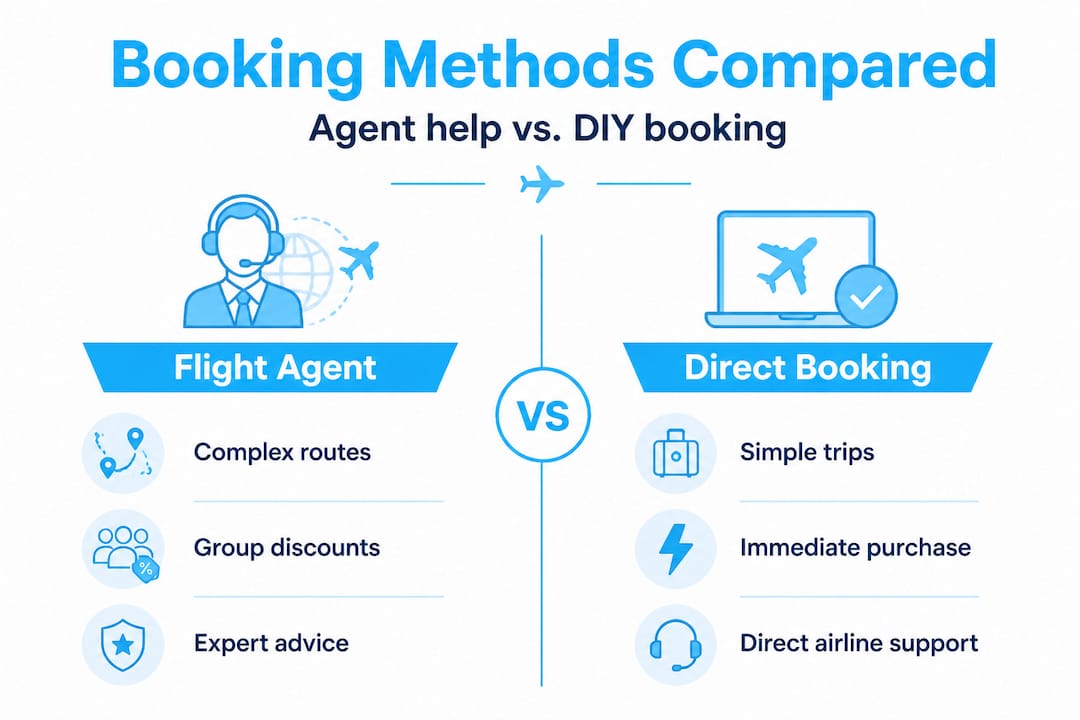
Flight comparison breakdowns show consistently that hybrid approaches outperform single-method booking for anything more complicated than a basic round trip. Industry changes, including airline “unbundling” (charging separately for services once included in the ticket price) and dynamic pricing algorithms that can change fares 200 times a day, make this hybrid strategy more effective now than it was five years ago.
As Travel + Leisure notes, direct booking wins on simplicity for straightforward itineraries, but complex trips benefit from the expertise of a specialist who understands the mechanics. The key word is “understand.” Don’t outsource your travel research entirely. Stay curious, compare often, and bring an agent in as a final optimization step rather than a first resort.
Find and compare the best flight and travel deals with PilotTravelDeals
You’re now equipped with a clear picture of when flight agents save you money and when booking direct is smarter.
PilotTravelDeals makes it easy to put this knowledge to work immediately. Our platform brings together fare comparison advantages from multiple airlines, OTAs, and booking sources in one place, so you can benchmark prices quickly before deciding whether to book yourself or take a quote to a specialist agent. Whether you’re planning a solo flight, a group trip, or a full itinerary with hotels and SIM cards for international data, our travel deal aggregation tools are built to help budget-conscious travelers find the best available rate fast. Start comparing now and see how much you could save on your next trip.
Frequently asked questions
Are flight agents always cheaper than booking direct?
Not always. Direct booking wins on simplicity and control for straightforward round trips, but agents often deliver better value and lower total costs on complex or multi-airline itineraries.
Can a flight agent get me group travel discounts?
Yes. Agents frequently have access to special group rates through airline group desks and private contracts that are not available to individual travelers shopping online.
What is the main difference between using an OTA and a flight agent?
OTAs are self-service platforms where you shop and book yourself. Flight agents offer personal expertise, access to exclusive fares, and can handle everything from complex itinerary management to disruption recovery on your behalf.
Should I always trust the cheapest fare an agent offers?
No. A low headline fare can carry hidden costs like strict change penalties, baggage fees, or non-refundable conditions. Always ask for a full breakdown of terms before committing to any booking.
How do I check if a flight agent is legitimate?
Look for IATA or ASTA accreditation, read recent customer reviews across multiple platforms, and confirm they provide you with a verifiable airline confirmation number (PNR) immediately after ticketing.
Recommended
- Smart ways to save money on flights every time – PilotTravelDeals.com
- Best Tips for Cheap Flights: Save More on Airfare – PilotTravelDeals.com
- Unlock cheaper airfare: insider strategies for saving – PilotTravelDeals.com
- Top Tips for Cheap Plane Tickets: Save on Every Flight – PilotTravelDeals.com
- Your Reliable Travel Agency – Morocco Tours