TL;DR:
- Last-minute travel deals are unpredictable, but with timing, tools, and flexibility, travelers can find genuine savings. Airlines and hotels adjust prices dynamically, often favoring discounts to fill remaining inventory closer to departure dates. Preparing in advance, monitoring multiple platforms, and verifying total costs help maximize value and avoid common booking mistakes.
You pull up flight prices on a whim, ready to book a spontaneous trip, and the numbers on your screen are almost insulting. Sound familiar? Millions of travelers assume last-minute automatically means last resort when it comes to pricing, but that’s not the full story. With the right timing, tools, and a flexible mindset, you can consistently find real value even when you’re booking days or hours before departure. This guide walks you through every step of the process, from understanding how prices actually behave to verifying that you genuinely scored a deal.
Table of Contents
- Know what to expect with last-minute travel prices
- Gather your tools: Sites and strategies for fast savings
- Step-by-step: How to book last-minute deals confidently
- Avoid common mistakes and verify your savings
- What most travelers misunderstand about last-minute deals
- Ready to score your next last-minute deal?
- Frequently asked questions
Key Takeaways
| Point | Details |
|---|---|
| Flexibility wins | Being open with travel dates, destinations, and airports unlocks the best last-minute savings. |
| Compare sources | Check direct sites and OTAs, and always look at bundle/package options before booking. |
| Move quickly | The best last-minute deals disappear rapidly, so act fast when you spot a price that fits. |
| Verify value | Double-check fees and compare rates to ensure you’re actually saving money. |
| Enjoy spontaneity | A flexible attitude turns last-minute travel into an adventure, not a gamble. |
Know what to expect with last-minute travel prices
Before you start frantically searching for deals, you need to understand how pricing actually works. The uncomfortable truth is that last-minute flights can cost more than booking weeks or months ahead, but prices can still shift downward as departure approaches. Airlines and hotels both use dynamic pricing, meaning algorithms adjust rates constantly based on demand, remaining inventory, and competition.
The key insight most travelers miss is that airlines and hotels would rather fill an empty seat or room at a discount than leave it completely unsold. That’s why genuine last-minute deals do appear, typically within a few days of travel. But they’re not guaranteed, and they won’t wait for you.
Here’s a general picture of how prices tend to behave across different booking windows:
| Booking window | Flight price trend | Hotel price trend |
|---|---|---|
| 3+ months ahead | Often lowest for popular routes | Lower, especially for peak seasons |
| 2 to 6 weeks ahead | Moderate, stable pricing | Moderate, some deals available |
| 1 to 2 weeks ahead | Can rise significantly | Mixed, deals possible midweek |
| 3 to 7 days ahead | Variable, can spike or drop | More frequent last-minute drops |
| Under 72 hours | Highest risk of premium pricing | Best chance of last-minute hotel deals |
“Building a plan around timing and willingness to adjust helps you navigate the unpredictable nature of last-minute travel pricing.” This philosophy is the foundation of every successful last-minute trip we’ve seen.
The biggest takeaway here is flexibility. If you have a fixed destination, a fixed travel date, and a fixed budget, last-minute booking is a gamble. But if you can shift your dates by even a day or two, or consider nearby airports, you multiply your chances of catching a real dip. Review our last-minute travel tips 2026 to see how these pricing patterns play out across different trip types, and check out our last minute deals explained guide for a deeper breakdown of inventory cycles.
Gather your tools: Sites and strategies for fast savings
The difference between travelers who score last-minute deals and those who don’t usually comes down to one thing: preparation. Specifically, having the right set of tools ready before you ever feel the urge to book.
The first move is to compare third-party marketplace rates against direct airline and hotel websites. This sounds obvious, but most travelers pick one platform and stop there. Wholesalers, which are companies that buy inventory in bulk and resell it, sometimes slash rates at the last moment to clear stock. That means a deal you’d never find directly on the airline’s site could be sitting on a third-party app.
Here’s a comparison of the most useful tools for last-minute deal hunting:
| Platform type | Best for | Speed of results | Deal depth |
|---|---|---|---|
| OTA (e.g., Expedia, Booking.com) | Bundles, packages | Fast | High for hotels |
| Airline direct sites | Flight-only deals | Fast | Moderate |
| Google Flights / Skyscanner | Price comparison | Very fast | High for flights |
| Dedicated deal apps | Flash sales | Real-time | Very high |
| Email/app price alerts | Passive monitoring | Automatic | Varies |
Key platforms and tactics to use together:
- Google Flights for broad price calendar views and flexible date searches
- Skyscanner’s “Everywhere” feature to find the cheapest destination from your home airport
- Hotel Tonight specifically designed for same-day hotel discounts
- Airline apps (set notifications for flash fare sales)
- PilotTravelDeals for aggregated deals across flights, hotels, and more in one place
Pro Tip: Don’t just monitor one platform. Open four or five tabs at once and refresh them simultaneously. Prices can differ by $50 to $200 for the exact same itinerary depending on where you look.
Bundles and packages deserve special attention. When an airline and hotel are bundled together through a wholesaler, the total price is often lower than booking each separately because suppliers want to move both at once. This is especially true within the final few days before travel. Our guide on why last minute travel deals exist explains the business logic behind these sudden price drops, and if you want to practice finding affordable routes fast, our tutorial on how to find random cheap flights is a great place to start.

Step-by-step: How to book last-minute deals confidently
Once your tools are set up, you need a repeatable process. Winging it doesn’t work nearly as well as following a structured approach, especially when deals can disappear in minutes. Here’s the method that consistently gets results.
1. Define your real constraints. Be honest about what you truly can’t change. If you must fly on a specific day, accept that your options are narrower. If you can leave any day within a four-day window, your odds of finding a deal improve dramatically.
2. Set flexible search parameters. Use flexible date search tools on Google Flights or Skyscanner. Enter your home airport and either a specific destination or “anywhere.” Look at the price calendar view and identify the cheapest days to fly.
3. Activate price alerts immediately. Set alerts on at least two platforms simultaneously. The moment you start thinking about a trip, set those alerts. You want to be notified the instant a price drops, not 20 minutes after someone else booked the last discounted seat.
4. Check nearby airports. Flying out of or into a secondary airport can cut costs significantly. If you’re near a major metropolitan area, there’s often a smaller regional airport within driving distance that serves cheaper routes.
5. Act fast when a real deal appears. This is where most people hesitate and lose. Deals within 72 hours of departure can appear and vanish within minutes as multiple travelers spot the same price drop simultaneously. Have your payment info ready, your passport details saved in the booking platform, and a clear sense of your ceiling price before you even start searching.
6. Book directly if the price matches. After finding a deal on a comparison site, quickly check if the airline or hotel’s direct site matches or beats it. Direct bookings sometimes include perks like free cancellation or loyalty points that offset a slightly higher sticker price.
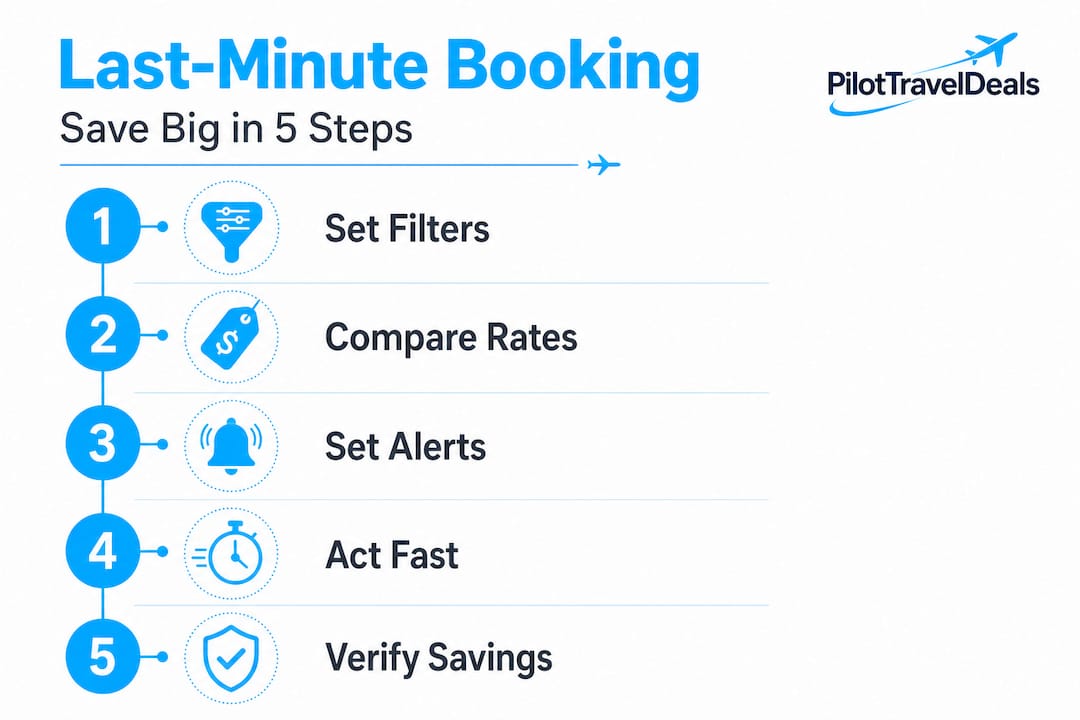
7. Screenshot and save your confirmation. The moment you book, screenshot your total price, the breakdown of fees, and the confirmation number. This protects you if anything changes and gives you a benchmark to verify your actual savings.
One powerful statistic to keep in mind: travelers who use multiple comparison platforms and have payment details pre-saved are significantly more likely to complete a booking before a flash deal expires. Speed is a real competitive advantage here. Our full breakdown on how to save up to 70% on flights and hotels shows real-world examples of this process in action, and our last minute flights guide covers airline-specific tactics in more detail.
Pro Tip: Keep a simple “travel-ready checklist” on your phone: passport location, credit card with travel benefits, bag already semi-packed. When a deal drops, your decision-making time shrinks to minutes.
Avoid common mistakes and verify your savings
Finding a low price is only half the job. The other half is confirming that you actually saved money and didn’t fall into one of the most common last-minute booking traps.
Mistake 1: Ignoring taxes and fees. A $79 flight that becomes $195 after fees is not a deal. Always expand the full price breakdown before celebrating. Budget airlines in particular are known for adding luggage fees, seat selection charges, and payment processing fees that inflate the base fare significantly.
Mistake 2: Assuming the first low price you see is the best. The very first result on any platform is often not the cheapest option after all fees are added. Sorting by “total price” rather than “base fare” gives you a much more honest comparison.
Mistake 3: Not cross-checking across sources. As mentioned earlier, comparing third-party rates against direct booking sites takes only two or three extra minutes and can save you $50 to $200 per trip.
Mistake 4: Booking in a panic. The urgency of last-minute travel can push you into making a poor decision. If you haven’t checked at least two platforms and verified the total cost, you’re not ready to book yet.
Here’s a quick verification checklist before you confirm any last-minute booking:
- Total price includes all taxes and fees
- Luggage allowance matches what you plan to bring
- Cancellation or change policy is documented
- Hotel check-in time works with your arrival
- You’ve checked the direct site for a price match
- Confirmation has been saved and screenshotted
Pro Tip: Use a single credit card with travel benefits for all last-minute bookings. Some cards offer trip delay insurance and price drop protection, which adds an extra layer of security when you’re booking under pressure.
Our guides on short notice flight savings and tips to book cheap flights go deeper into fee structures and verification steps, specifically for budget travelers who want to be certain they’re getting real value.
What most travelers misunderstand about last-minute deals
Here’s the perspective most travel guides won’t give you directly: the majority of people chasing last-minute deals are actually chasing a fantasy version of spontaneous travel that rarely matches reality.
The fantasy goes like this: you decide to travel tomorrow, open an app, find a $99 round-trip to a dream destination, and off you go. That scenario does happen, but it’s far less common than travel influencers suggest. The travelers who consistently win at last-minute booking aren’t winging it. They’re prepared, flexible, and patient. That’s a very different skillset than pure spontaneity.
The biggest mistake is treating last-minute booking as a binary outcome: either you get a steal or you pay full price. In reality, most last-minute wins fall somewhere in the middle. You might save 30% on a flight but pay closer to standard rates for a hotel. Or you might find a genuinely cheap hotel but spend a normal amount on airfare. Calling that a failure misses the point entirely.
Calculated flexibility beats pure risk-taking every single time. The travelers who understand the impact of last-minute booking on both price and experience are the ones who come home happy, regardless of whether they saved 20% or 60%.
Sometimes the real value of a last-minute trip has nothing to do with the dollar amount you saved. The adventure of not knowing exactly where you’re going until 72 hours before, the thrill of acting on a deal, the freedom from over-planning: those things have genuine worth. Build your strategy around maximizing both financial value and that experience, and you’ll never feel like last-minute travel failed you.
Ready to score your next last-minute deal?
You now have a full playbook for finding, evaluating, and booking last-minute travel deals without the stress or the overpaying. The next step is putting it into practice with the right resources behind you.

PilotTravelDeals.com keeps a live catalog of deals on flights, hotels, and travel bundles, updated constantly so you’re always seeing current prices. Whether you need step-by-step help with affordable domestic flights or want to follow a guided walkthrough for step-by-step hotel booking, the tools are ready when you are. You can also follow along with our detailed guide to booking cheap flights step by step to sharpen your process before your next deal appears.
Frequently asked questions
How close to departure can I realistically find last-minute deals?
Deals within 72 hours of departure do appear, but you need to monitor platforms constantly and be ready to book the moment a credible price drop hits.
Is it cheaper to book flight and hotel together at the last minute?
Bundled packages can be cheaper than booking separately, especially within the final few days, as suppliers offload unsold inventory through wholesalers at reduced rates.
Are last-minute travel deals always guaranteed to save money?
No. Last-minute prices are often higher than booking in advance, so your actual savings depend heavily on flexibility, research effort, and timing luck.
What’s the best way to get notified about true last-minute deals?
Set price alerts on at least two or three travel platforms simultaneously, including airline apps, so you’re among the first to see any deal drop in real time.
Should I wait for prices to drop further as departure nears?
Waiting is risky because prices can spike just as easily as they drop; when a price feels right for your budget and destination, take it rather than gambling on a better number that may never come.
Recommended
- Last-Minute Travel Tips: Save Up to 70% on Flights & Hotels – PilotTravelDeals.com
- Top tips for booking last-minute travel deals in 2026 – PilotTravelDeals.com
- Last Minute Deals Explained: Smart Travel Savings – PilotTravelDeals.com
- Last-Minute Booking: How It Changes Travel Planning – PilotTravelDeals.com