
TL;DR:
- Travel savings are accessible to everyone with proven, practical strategies for flights, hotels, and packages. Using free tools, loyalty programs, and smart timing, travelers can significantly cut expenses without sacrificing experience. Flexibility and understanding when to bend or follow rules maximize savings and create more fulfilling trips.
Picture this: you’ve been dreaming about a trip for months, you finally search for flights and hotels, and the prices are twice what you expected. It feels like travel savings are a myth reserved for people with insider connections or endless free time to hunt for deals. They’re not. The strategies in this guide work for everyday travelers, and they’re repeatable, practical, and proven. Whether you’re planning a domestic weekend getaway or an international adventure, you’ll learn exactly how to cut costs on flights, hotels, and vacation packages without sacrificing the experience you want.
Table of Contents
- Essential tools and tactics for travel savings
- Step-by-step: Booking flights at the lowest prices
- Hotel booking hacks: Timing, loyalty, and negotiation
- Unlocking serious value: Credit card points and reward programs
- Common pitfalls and when to break the rules
- Why maximizing travel discounts is more art than science
- Level up your savings with curated travel deals
- Frequently asked questions
Key Takeaways
| Point | Details |
|---|---|
| Use comparison tools | Always check multiple sites and set price alerts to find the lowest travel rates easily. |
| Book strategically | Flights are cheapest when booked mid-week and hotels offer the best deals 7–10 days before your stay. |
| Maximize rewards | Hotel loyalty programs and credit card points can unlock major savings—even free nights or flights. |
| Stay flexible | Being open to last-minute deals or nontraditional booking methods can result in deep travel discounts. |
Essential tools and tactics for travel savings
With a clear idea of what you want to save on, let’s look at the essential tools and membership strategies that make deep discounts possible. The good news is that most of the best tools are completely free to use.
Start with Google Flights for airfare research. It’s one of the most powerful fare tracking tools available, letting you view price trends over time, see flexible date calendars, and set automated alerts. Hopper is another excellent app that predicts whether prices will rise or fall and tells you the best moment to buy. For hotels, HotelTonight specializes in same-day and short-notice deals that can’t be found anywhere else.
On the comparison side, using travel comparison sites like Booking.com, Hotels.com, and Expedia gives you a side-by-side look at rates across hundreds of properties. No single platform always wins on price. That’s why checking two or three sources before booking is a non-negotiable habit for budget-conscious travelers. Google Flights price alerts combined with cross-platform comparison can produce 10 to 30% hotel savings, and booking hotels 7 to 10 days out often triggers last-minute drops of up to 40%.
Key tools at a glance
| Tool | Best for | Cost |
|---|---|---|
| Google Flights | Flight research and fare alerts | Free |
| Hopper | Price prediction and timing | Free |
| HotelTonight | Same-day hotel deals | Free |
| Booking.com | Hotel price comparison | Free |
| Hotels.com | Loyalty rewards on hotels | Free |
| Expedia | Flight and hotel bundles | Free |
Beyond apps and comparison sites, free loyalty programs are one of the most overlooked weapons in a budget traveler’s toolkit. Hotels.com rewards, Marriott Bonvoy, and Hilton Honors all offer free enrollment. You don’t need to be a frequent traveler to start earning. Even a couple of stays per year add up to free nights over time. For seamless planning on the go, mobile travel booking explained breaks down how to get the most from booking apps without overpaying.
Key habits that separate smart savers from average travelers:
- Set price alerts on at least two platforms before booking anything
- Always clear browser cookies or use incognito mode to avoid dynamic pricing
- Sign up for loyalty programs before your first qualifying stay, not after
- Check the hotel’s direct website after finding a comparison price
- Subscribe to airline newsletters for flash sales and seat sales sent directly to your inbox
Step-by-step: Booking flights at the lowest prices
Once you’re equipped with the right tools, it’s time to put them to work for the largest travel expense: airfare.
Step 1: Start tracking early. Set fare alerts on Google Flights and Hopper as soon as you know your rough travel window. Don’t wait until you’re ready to commit. Tracking prices over several weeks reveals the normal price range for your route, which makes a genuine deal obvious when it appears.
Step 2: Book on the right day. Airlines release sales mid-week, and Tuesday or Wednesday booking typically delivers 10 to 20% savings compared to weekend searches. Weekend searchers often pay a premium because demand spikes when most people have time to browse.
Step 3: Get your timing right. For domestic flights, early booking for travel deals peaks at one to three months before departure. International flights are a different story, with the sweet spot landing at two to four months out. Booking too early can actually cost more because airlines hold back inventory at lower prices until competition heats up.
Step 4: Consider nearby airports. Flying into or out of a secondary airport within 60 to 90 miles of your destination can slash fares significantly. If you’re heading to New York, compare JFK, LaGuardia, and Newark. For Los Angeles, check Burbank and Long Beach alongside LAX.
Step 5: Use bundling with caution. Packaging your flight with a hotel booking through Expedia or Booking.com can sometimes shave 10 to 15% off the combined total. The catch is that bundles often come with stricter cancellation terms. If your plans are even slightly uncertain, buying separately gives you more flexibility to swap or cancel without large penalties.
Statistic callout: Booking a domestic flight one to three months out and choosing a Tuesday or Wednesday departure can save budget travelers an average of $80 to $150 per round trip compared to last-minute weekend fares.
Pro Tip: Use Google Flights’ “Explore” map feature to search broadly by region rather than a fixed destination. Sometimes a nearby city you hadn’t considered is 40% cheaper to reach, and a short train or bus ride closes the gap.
For detailed strategies on domestic routes specifically, the affordable domestic flights guide walks you through the exact process step by step.
Hotel booking hacks: Timing, loyalty, and negotiation
With flights secured at a discount, next up is hotels, where timing, loyalty, and negotiation can dramatically cut costs.

Timing is everything in hotel pricing. The conventional advice says “book early,” but that rule applies far more to flights than hotels. Hotels price their rooms dynamically, and unsold rooms close to the check-in date become a liability. That pressure creates real discounts. Booking hotels 7 to 10 days before your stay often delivers the biggest price drops, sometimes reaching 40% below the standard rate.
Hotel savings comparison
| Booking window | Average discount | Best strategy |
|---|---|---|
| 3+ months out | 5-10% | Best for peak season or events |
| 4-6 weeks out | 10-20% | Safe balance of choice and price |
| 7-10 days out | 20-40% | Flexible travelers only |
| Same day | 30-50% | HotelTonight app, high risk |
Loyalty programs are free money. Joining free hotel loyalty programs like Marriott Bonvoy or Hilton Honors earns you a free night for roughly every five paid stays, reducing your effective per-night cost by 15 to 20% over time. These programs also unlock member-only rates that aren’t visible to regular visitors on comparison sites. Always check if a member rate exists before you finalize any booking.
Direct negotiation beats algorithms. Most travelers assume the price on screen is final. It often isn’t. Calling the hotel directly, especially for stays of three or more nights, can unlock rates 5 to 10% lower than anything listed online. Hotels prefer direct bookings because they avoid the commission fees paid to third-party platforms. You can simply ask: “Is this your best available rate for my dates?” More often than you’d expect, the answer comes with a lower number.
“The front desk has pricing authority that algorithms don’t. A polite two-minute phone call has saved seasoned travelers hundreds of dollars on a single booking.”
For a deeper look at saving on hotel bookings and smart ways to save on hotels, those resources cover specific tactics for different hotel types and destinations.
Pro Tip: Always ask about upgrade availability at check-in, not during booking. Hotels frequently offer free or heavily discounted upgrades to loyalty members who simply ask politely when they arrive.
Unlocking serious value: Credit card points and reward programs
After using direct savings strategies, you can boost free travel value even further with the right rewards credit cards and point systems.
The single biggest accelerator in travel savings isn’t a sale or a coupon. It’s a credit card sign-up bonus. Earning 50,000 to 80,000 sign-up points translates to $750 to $1,600 in travel value, and Chase Ultimate Rewards points average 1.87 cents per point through airline and hotel transfer partners. Used strategically, that’s $1,200 to $2,400 in annual free travel value.
Cash back vs. points: Which wins?
| Factor | Travel points | Cash back |
|---|---|---|
| Top value per dollar spent | 1.87+ cents | 2 cents max |
| Effort required | High | Low |
| Best redemption | Airline/hotel transfers | Statement credit |
| Annual free travel potential | $1,200-$2,400 | $400-$600 |
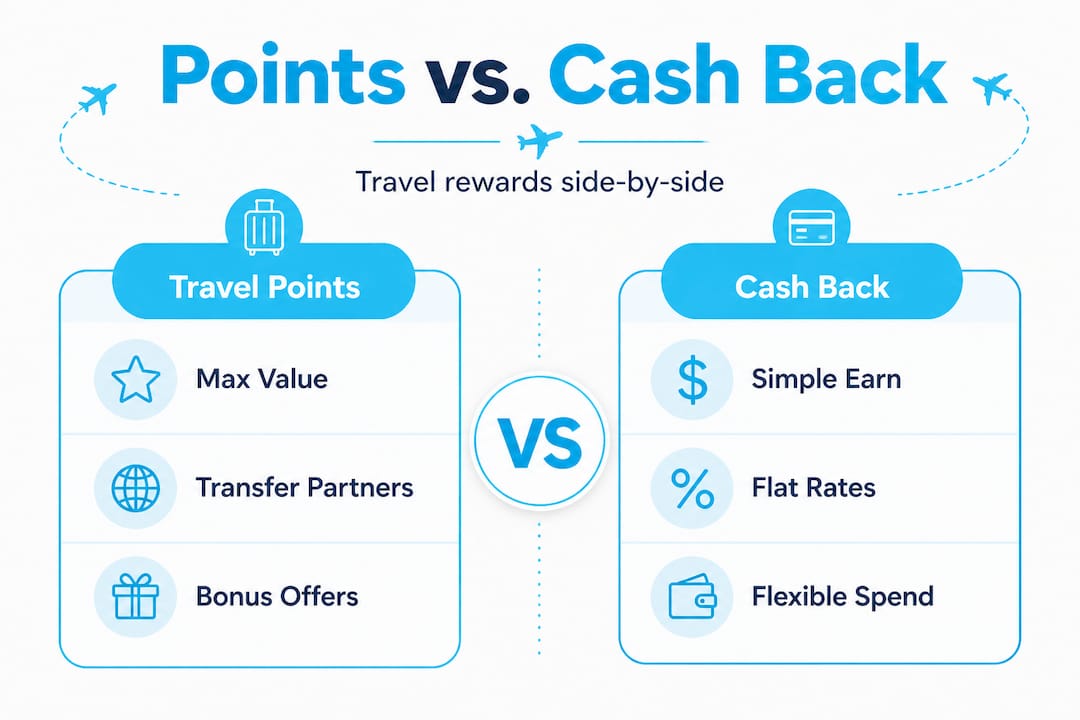
Points outperform cash back at 1.5 cents per point or higher through transfer partners, delivering a return equivalent to 3.74% on spending. A standard 2% cash back card can’t match that ceiling. The trade-off is effort. Points require you to research transfer ratios, understand partner programs, and plan redemptions in advance. Cash back is simpler but caps your return significantly.
Four numbered steps to maximize reward points:
- Choose a card with a strong sign-up bonus and no annual fee for the first year
- Use shopping portals tied to your card to earn bonus points on everyday purchases
- Transfer points to airline or hotel partners rather than redeeming for gift cards or merchandise
- Aim for a minimum redemption value of 1.5 cents per point before pulling the trigger
Pro Tip: Never redeem points for cash or gift cards. The value drops to 0.6 to 1 cent per point in those categories. Always transfer to travel partners or book directly through the card’s travel portal for maximum return.
Common pitfalls and when to break the rules
While these strategies maximize savings in most cases, real-world travel offers exceptions. Knowing when to bend the rules greatly increases your total savings.
Don’t default to bundles blindly. Package deals can produce unbeatable all-in rates, but they lock you into rigid plans. If a travel disruption hits one component of your bundle, unraveling the whole thing becomes complicated and costly. Evaluate bundles against separately booked options before committing.
Same-day booking is risky and rewarding. The HotelTonight app for same-day deals can produce discounts of 40 to 50% for travelers who are truly flexible. This isn’t a strategy for family vacations or trips with fixed event tickets. But for solo travelers or couples with open schedules, the upside is real and substantial.
The redemption gap is costing travelers serious money. Empirically, 61% of travelers make suboptimal redemptions, leaving $400 to $800 per year on the table. Points expire, get redeemed for low-value items, or simply sit unused while their owners pay cash for trips. This single mistake erases more savings than almost any other error in travel planning.
Break the “book early” rule for hotels when you’re genuinely flexible. The flexibility has to be real. If you have a conference to attend or kids in school, you can’t gamble on last-minute availability. But if you can pick up and go on short notice, watching last-minute travel tips gives you an edge that rule-followers never access.
Avoid these common mistakes:
- Booking flights on weekends when demand and prices are highest
- Ignoring loyalty programs because “you don’t travel enough to bother”
- Redeeming points for merchandise instead of travel
- Assuming the comparison site price is always the final lowest price
- Skipping travel insurance on non-refundable bookings
Understanding which mobile booking apps overview tools fit your travel style makes it easier to know when a same-day app is worth the risk versus when stable pricing and advance booking is the smarter play.
Why maximizing travel discounts is more art than science
Every strategy in this guide works. But not every strategy works every time, for every traveler, on every trip. That distinction matters far more than most advice acknowledges.
The travelers who consistently save the most aren’t the ones who rigidly follow the “book Tuesday, join every loyalty program, always avoid bundles” formula. They’re the ones who understand why each rule exists, so they know exactly when to break it. Booking a hotel 7 days out saves money because of inventory pressure. If you’re traveling during a sold-out event weekend, that logic inverts entirely and early booking wins.
Your risk tolerance shapes your savings potential in real, practical ways. If the thought of arriving somewhere without a confirmed hotel reservation feels genuinely stressful, the same-day app strategy will cost you peace of mind regardless of the discount. That trade-off is worth acknowledging. A deal that creates anxiety isn’t actually a good deal for you.
Seasoned travelers blend textbook tactics with instinct built through experience. They know when a price feels genuinely low versus when it’s just framed to look that way. They check advanced booking for travel savings data against their own past booking results. And they treat every trip as a learning iteration, adjusting based on what worked and what didn’t.
The best approach is to pick two or three strategies from this guide that match your travel style and actually practice them on your next booking. Mastery of a few tactics beats surface-level awareness of ten.
Level up your savings with curated travel deals
Ready to put these strategies to the test? The tools and knowledge are only part of the equation. Having a trusted source that aggregates real-time discounts in one place is what turns strategy into actual savings.
At PilotTravelDeals.com, you can find top hotel deals using comparison tools built specifically for budget-focused travelers. Whether you’re looking for a step-by-step hotel booking experience or want to explore the full range of types of travel discounts available right now, the platform brings together flights, hotels, and travel services with savings up to 80%. Stop leaving money on the table. Start every trip with smarter research and let curated deals do the heavy lifting.
Frequently asked questions
What is the best day of the week to book flights for discounts?
Tuesday and Wednesday are the top days to book flights, as airlines release sales mid-week and competition tends to push prices lower compared to weekend searches.
How far in advance should I book hotels to get the best price?
Booking 7 to 10 days before your stay often gets the biggest last-minute hotel discounts, with last-minute drops up to 40% off the standard rate for flexible travelers.
Are loyalty programs really worth joining for hotel stays?
Yes. Free hotel loyalty programs like Marriott Bonvoy and Hilton Honors earn you a free night roughly every fifth stay, reducing your average nightly cost by 15 to 20% over time.
Is it better to earn travel points or cash back on credit cards?
Travel points usually deliver more value when redeemed through transfer partners at 1.5 cents or more per point, but they require more strategy and planning compared to straightforward cash back.
Can you actually save money booking travel last minute?
If you’re truly flexible, apps like HotelTonight offer same-day deals of 40 to 50% off, though the risk increases significantly for nonrefundable bookings or trips with fixed plans.
Recommended
- Best Hacks to Get Cheaper Flights for Big Savings – PilotTravelDeals.com
- How to book group travel cheaply: 5 steps to big savings – PilotTravelDeals.com
- How to Maximize Travel Savings with Smart Deal Strategies – PilotTravelDeals.com
- 8 Smart Ways to Travel for Cheap and Save Big Money – PilotTravelDeals.com
- Budget Planning for Vietnam Tours | VietnamTourPackage.sg
- 10 time-saving travel hacks for pilgrims using smart tools